Minors and Concentrations

Minors
The School of Architecture offers two collaborative minor programs for students interested in architecture and construction management.
Construction Management (MCM)
The Minor in Construction Management is a five-course, 15-credit program that prepares students for careers in design, construction management, and contracting by combining technical, leadership, and business training with multidisciplinary coursework.
Offered by: Department of Civil and Environmental Engineering and Earth Sciences (CEEES) and the School of Architecture (SoA)
Minor in Architecture
The Minor in Architecture is a five-course, 15 credit program that prepares students to join firms with an integrated project delivery framework, or to gain employment with traditionally structured companies which interact heavily with their counterparts in the design realm. View the current bulletin for course information. Contact John Mellor (jmellor@nd.edu) with questions.
Concentrations
The School of Architecture encourages undergraduate students, beginning in their fourth year, to participate in one of three concentrations:
These concentrations develop specialized skills that benefit students in the workplace and beyond.
Architectural Practice & Enterprise
The Architectural Practice and Enterprise concentration, established in 2007, allows architecture students to take courses in accounting, management, corporate finance, and other business topics through Notre Dame’s Mendoza College of Business. Admission into the concentration is competitive; students who are interested in pursuing the concentration should contact the Undergraduate Advising Program Director for more information.
Furniture Design
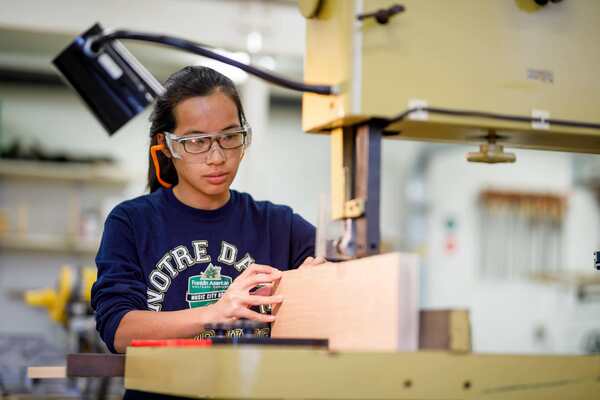
Officially recognized in 1997 after nearly a decade of being taught at the School, the Furniture Design concentration allows students a unique opportunity to study furniture design in an architectural context. The two-year concentration consists of four furniture studio classes. Like the School's overall focus, these courses expose students to traditional architectural detail and ornament.
The furniture shop is fully equipped with a machine shop, as well as hand tools for carving. Students are required to construct furniture of original design gaining valuable knowledge in the use of materials while maintaining a high level of craft and esthetics.
Preservation and Restoration
Since the fall of 2007, architecture students entering their fourth year have been able to participate in the Preservation and Restoration concentration. This concentration includes the following courses: Research and Documentation of Historical Buildings, History of American Architecture 1630-1915, Historic Preservation and Traditional Construction, and History and Theory of Preservation.
The Preservation and Restoration Concentration is a direction in which the School can lead and show how traditional designs are sustainable. Example projects:
Analysis and Documentation of Copshaholm, the Oliver Mansion, a historically significant building located in downtown South Bend - The work completed in the students' report serves the Northern Indiana Center for History and their efforts towards preserving, restoring, conserving, repairing and appropriately maintaining this structure. Students focused on a thorough analysis both of the exterior and interior and provided detailed documentation that describes the conditions.
Documentation for the Revitalization of Downtown South Bend - Students prepared a strategy for the long-term sustainable development of downtown South Bend, Indiana. Students worked with South Bend city officials, planners and preservationists to create a proposed master plan for the downtown core.