
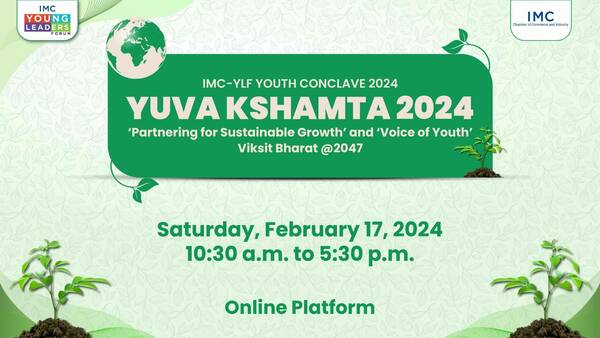
Every year thousands of industry leaders, young entrepreneurs, and students from around the world gather to attend the IMC-YLF Conclave. Professor Krupali Krusche participated in last year's ice breaker session, offering valuable perspectives to the global audience. The transcript of her remarks can be read below.
It is a privilege to be part of an event that celebrates the dynamism and the potential of India's youth, a driving force for the nation's progress. Climate change is real, and it is going to affect you the most. This is nobody else's fight, stand up and join Prime Minister Modi ji to become the actors of change. As we grapple these unprecedented climate shifts, it compels us to question our actions and their repercussions. The responsibility to care for our common home, to foster sustainable practices lies not just with the global community, but with us. Within our community we must reflect on what we are doing right and where we may be falling short. I acknowledge the efforts that have been channeling the energy of the youth. A sentiment echoed very often by the flagship of IMC youth programs. As we gather here under the theme of partnership for sustainable growth and the voice of the youth, I am compelled to shed light on the impact of climate change on urbanization, specifically in the context of Bharat.
In recent times, the Intergovernmental Panel on Climate Change AR6 report from the United Nations has brought to our attention the alarming consequences of climate change on cities across South Asia, including those in India. The report underscores the connection between urbanization and intense rainfall, emphasizing how cities in India are grappling with challenges posed by changing climate conditions. How many of you have experienced rapid climate change within your own city or town in recent years? Now allow me to connect the pressing environmental issues we discussed earlier with the theme of the Conclave and regional contexts. The challenges we face locally such as extreme weather conditions, and the potential designation of a region, as a climate refuge area, highlights the urgency of sustainable planning. In our community, we have the opportunity to make decisions that could turn this region into climate neutral, or even climate positive places.
I spoke earlier about global perspectives. But let us zoom into our daily lives, our actions matter. And our decisions can impact not only our present, but the future of our children, and the generations to come. In the broader context of regional planning, we need to be cautious not to repeat the mistakes of the past. The consequences faced by regions with rapid wildfire, droughts should show us as a stark reminder, our goal should be to transform our Earth into an oasis, a place where people want to live and thrive, but without compromising the delicate balance of our ecosystems.
This brings us to a critical crossroad where sustainability and urban planning transect. As the cities grow, decisions about land use and infrastructure development become paramount. The urgency lies in the understanding that the potential impact of sea level rise before introducing new infrastructure should be considered. The construction sector contributes to a significant share of greenhouse gas emissions and is a pivotal player. However, discussions often overlook the broader urban effects on climate based on this aspect of construction. Cities like Mumbai, Delhi, Chennai, and Kolkata are major contributors to climate change due to urban activities and planning. Transportation and buildings influenced by urbanization contribute to a staggering 75% of global carbon emissions. Beyond our built environment, the consequences of climate change manifests in various forms, from glacial melt to sea level rise, water scarcity, storms, hurricanes, floods, and wildfires. The report highlights the intensification of rainfall in South Asian cities due to urbanization. With the prediction of a population explosion in Asia, especially in India, our cities face the challenge of visionary expansions to accommodate large densities while grappling with adverse impacts of climate change.
As we discuss these issues, it is critical to recognize the solutions that start at an individual level. You can make a difference. We need to consider how we design our cities, where we invest in our infrastructure and how we balance urban development with environmental conservation. I touched upon the impact of transportation choices on our environment, it is high time to evaluate our reliance on cars, and explore alternatives, create a better public transportation network, focusing on walkable neighborhoods, and supporting local markets can significantly reduce our carbon footprint. The delicate balance between urban development and green spaces is pivotal. It is not just about farmlands. It is about how we use and preserve all our land resources. A compact, dense city footprint minimizes the urban heat island effect and promotes a healthier environment.
Now let us address the issue of farming that is so close to our hearts. Our choices in farming practices directly impact our health and environment. By supporting local produce, we not only encourage healthier eating habits, but also contribute to a more sustainable agricultural system. I also want to emphasize the interconnectedness of our actions with the broader ecosystem. The health of our cities, rural areas, and forests are intertwined. When we destroy forests, we upset this balance, leading to catastrophic events like floods, tsunamis, and wildfires. Our decision today can shape a better future for us and for the generations to come.
In conclusion, the urgency of sustainable growth and climatic conscious urban planning cannot be overstated. As we discuss partnering for sustainable growth, let us remember that the decisions we make today will shape the future of generations to come. I am hopeful that the collective intelligence and passion of the young minds gathered here will contribute to the innovative solutions, advocacy for sustainable practices, and a shared commitment to build a resilient and environmentally conscious future.
Thank you for the opportunity to share these thoughts with you today. May the discussions at the conclave inspire action and collaboration that pave the way for a sustainable and prosperous Bharat.