
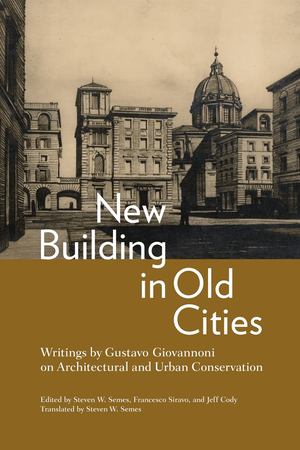
“When I came to Italy to teach in 2007, I didn’t know much about the traditional architects of the early 20th century beyond names in history books like Terragni, Libera, Moretti. My colleague, Ettore Mazzola, through his book A Counter History of Modern Architecture in Rome, introduced me to them,” Steven Semes, professor at the University of Notre Dame School of Architecture, recalls how he encountered the works of Gustavo Giovannoni, an influential Italian architect and engineer with pioneering ideas on integrating new ideas within historic architecture.
Semes recently translated thirty excerpts from Giovannoni’s writings on traditional architecture, in his book Today, Giovannoni is cons New Building in Old Cities: Writings of Gustavo Giovannoni on Architectural and Urban Conservation (Getty Publications, 2024), with co-editors Jeff Cody and Francesco Siravo. Today, Giovannoni is considered a critical resource for practitioners, professors and students about the revival of traditional architecture and new urbanism.
“As my Italian improved, I read more of Giovannoni’s work,” Semes said. “I appreciated his influence, and how together with other architects of that period in Rome were not known outside of Italy. They became my focus because I believed in what they were doing.”
An architect-scholar, Semes sees the practice and scholarship of architecture as synergistic. Driven by his curiosity on how architecture has been framed intellectually in modern history, he found Giovannoni’s work compelling, “Having given coherent theoretical expression a century ago to a set of ideas that I found extremely congenial, parallel to what I valued before knowing about him, and aligning with what we are doing here at Notre Dame and the profession at large. In him I found a mentor.”
Over time Italian scholars have brought Giovannoni’s work out of obscurity, partly due to his opposition to modernism, which Bruno Zevi described as, “an obstacle to progress.” In New Buildings in Old Cities: Writings by Gustavo Giovannoni on Architectural and Urban Conservation, Semes introduce Giovannoni’s work and his contemporaries to the world, expanding on earlier Italian scholars’ efforts, including exhibitions, publications, and studies of figures like Brasini.
In this anthology, Semes, Siravo, and Cody structure their book into six thematic concepts delving into Giovannoni’s conservation principles for carefully preserving, restoring, and integrating heritage sites; urban building, respect for the setting or context, thinning out of the urban fabric, restoration treatments, the grafting of the new upon the old, and reconstruction.

“Giovannoni uses botanical imagery that ties these six parts together, describing the city as a living organism rather than an artifact or a fossil. It’s something that’s still alive, that people live in and continue to shape, it continues to grow and change,” says Semes, “When talking about thinning out of the urban fabric, Giovannoni uses the term diradamento derived from diradare—to prune or thin out an orchard or forest to promote growth of valued plants. It’s an ethic of care, a concept I developed in my previous book The Future of the Past.”
Giovannoni uses innestare—grafting in defining new and old. “When adding to an old building or extending a historic city, you graft the new parts,” he analogized. Bringing new desired qualities and maintaining continuity, adding to a historic city without necessarily imitating existing buildings, but allowing the old and new to ‘grow’ together, Semes said. This integration makes the new and old non confrontational, with continuity.
“There should not be a contrived separation or rupture while incorporating new technologies, purposes, and ideas, that the past and present be partners,” Semes said. Giovannoni saw modernism as an existential threat to historic cities.
As Semes developed a theoretical understanding of what he had sought to do in practice or what he was seeking to do as a teacher, Giovannoni’s writings became an important framework for him. Semes notes some of these concepts he adopted into his reflection include the idea that the central subject of conservation is not just individual buildings or isolated monuments, but the urban fabric as a whole giving meaning and setting. The idea that a historic city could, in its entirety, be considered a monument. An idea that Giovannoni injected into the Athens Charter of 1931, which led to the establishment of historic districts. Semes believes that theory is a reflection on practice, not just abstract ideas for their own sake.
In 1919, Giovannoni founded the School of Architecture at the University of Rome, creating its curriculum and teaching two generations of Italian architects before and after the Second World War. His curriculum remained until the uprisings of 1968, and his name was omitted until now that he’s being rediscovered. “What we are doing here at Notre Dame is very similar to Giovannoni’s curriculum and writings on training architects.” With a grin across his face, Semes adds, “He essentially theorized the school’s mission and pedagogy, before we happened upon it. And Thomas Gordon Smith came along and established the classical curriculum that, without knowing, really remarkably parallels what Giovannoni established in Rome in 1919.”
“What we are doing here at Notre Dame is very similar to Giovannoni’s curriculum and writings on training architects.”
Semes appreciates the tremendous expansion and deepening as illuminated by Giovannoni’s thinking on sustainability, something Giovannoni approached while everyone was interested in modernization and industrialization at the time. “He valued materials and building techniques that last, even though he and nobody at the time could foresee reinforced concrete’s durability issues beyond 50 years. But the idea that materials and methods should be long-lasting and durable is something that he valued.”
Following the positive reception of New Buildings in Old Cities and a series of related public lectures, Semes has his sights set on the next book project, saying “I started it years ago, but set it aside for the Giovannoni book. A volume dedicated to Giovannoni’s contemporaries in Rome showcasing a dozen brilliant architects lesser-known outside of Italy and not in the history books, but should have been. Building on this book, it would be a wider zooming out and looking at the whole group of architects who were practicing at the time in Rome.”
The broad accessibility and clarity of New Buildings in Old Cities allow it to resonate with both the general public and specialized professionals, illustrating its appeal across different audiences. “I’m hoping that people, regardless of where they fit on that spectrum, will find it both useful and engaging,” he asserts. In the months after publishing, Semes brought his insights to audiences in Philadelphia at University of Pennsylvania and Athenaeum of Philadelphia, Washington DC, New York, Boston, and the Duda Forum on Historic Preservation and Sustainable Development in San Antonio, Texas.
Reflecting on his practice and scholarship, Semes has now taken keen interest in learning from others, including his students. “I’ve done a lot of talking over the last forty years. Now, what I want to do is to really just listen, hear what others have to say,” he said, adding that he is still learning to learn.
Written by Charles Ghati, MSHP Candidate, Class of 2025. Charles is a registered architect in Kenya, where he practiced before joining the Notre Dame School of Architecture.