tag:architecture.nd.edu,2005:/news-and-media/newstag:architecture.nd.edu,2005:/latestSchool of Architecture | News2026-08-27T14:42:00-04:00The University of Notre Dame School of Architecture emphasizes classical and vernacular architecture within traditional urbanism; principles that encourage community, harmony with nature, and economy of resources and energy.tag:architecture.nd.edu,2005:News/1851082026-08-27T14:42:00-04:002026-08-27T14:44:08-04:00Architecture Program Receives STEM Designation, Recognizing the Growing Integration of Design, Technology, and Science
The University of Notre Dame School of Architecture’s degree programs were recently granted STEM designation, recognizing the growing integration of science, technology, engineering, and mathematics within architectural education and design.
At Notre Dame, the designation acknowledges the technical and scientific rigor already embedded in architectural education while affirming the School’s commitment to architecture as both a humanistic and design discipline.
“Architecture has always existed at the intersection of art, science, technology, and human experience,” said Francis and Kathleen Rooney Dean Stefanos Polyzoides. “This designation gives formal recognition to the depth of technical knowledge our students develop while reinforcing the larger purpose of architectural education: to design buildings and places that serve people well, endure over time, and respond intelligently to changing environmental and societal conditions.”
Across the curriculum, students engage with building technology, structures, environmental systems, computational methods, sustainability, emerging technologies, and digital design and fabrication. “It formally acknowledges the breadth of knowledge that architectural education already brings together and the increasingly interdisciplinary nature of architectural practice,” said Director of Graduate Studies Richard Economakis.
Beyond the classroom, the designation also reflects the important role architects play in responding to some of the most pressing challenges facing cities and communities. Buildings and urban environments must increasingly respond to climate change, resource constraints, and rapidly evolving methods of design and construction. Preparing future architects for these challenges requires an education that connects creative practice with rigorous technical and analytical knowledge.
“It reinforces our belief that architects must be able to imagine better environments while also understanding how those environments perform, how they are constructed, and how they can contribute to a more resilient and sustainable future,” said Director of Undergraduate Studies John Mellor.
The new designation takes effect in Fall 2026 and applies to the Bachelor of Architecture, Master of Architecture, and Master of Architectural Design and Urbanism programs.
]]>
McKenzie Lookebilltag:architecture.nd.edu,2005:News/1845512026-08-04T10:46:00-04:002026-08-04T10:46:50-04:00School of Architecture to partner with City of Benton Harbor to guide riverfront redevelopment
On Monday (Aug. 3), the University of Notre Dame School of Architecture’s Housing and Community Regeneration Initiative, in partnership with the City of Benton Harbor, the Southwest Michigan Planning Commission and Cornerstone Alliance, will launch a community-driven planning process to create a shared vision for the St. Joseph Riverfront in Benton Harbor.
The partnership will begin with an invitation to residents, business owners and community stakeholders to participate in a series of listening sessions on Aug. 5, followed by a weeklong public urban planning session conducted by the Housing and Community Regeneration Initiative with public events on Aug. 17, 18 and 20. All events will start at 5:30 p.m. and be held at the Benton Harbor Urban Innovation Lab, 510 W. Main Street.
This process, known as a Dean’s Charrette, will result in a shared long-term vision for the riverfront as well as a regeneration plan for downtown, which will help guide future investments in housing, recreation, public spaces, connectivity and economic development.
"Our community’s waterfront represents our shared future — a future where neighbors come together to enjoy world-class public spaces, programming and recreation, where new housing and investment will flourish, and a place we can all be proud of for generations to come,” said Benton Harbor Mayor Marcus Muhammad. “This process gives our community the opportunity to move from ideas to action, transforming vacant spaces into vibrant places.”
“This work will draw on Benton Harbor’s rich history and strong community to provide a plan to activate the riverfront and regenerate downtown by creating places of lasting value.”
Directed by Professor Marianne Cusato, the School of Architecture’s Housing and Community Regeneration Initiative will lead the planning and design process. Known for its collaborative "Think-and-Do Tank" approach, the initiative works alongside communities to develop practical, community-informed solutions that strengthen neighborhoods and local economies.
To date, the initiative has conducted nine charrettes in six cities across the region, including in South Bend, Elkhart and Gary, Indiana; and Kalamazoo, Michigan.
“We are thrilled to partner with Benton Harbor to facilitate a process that establishes a plan to offer actionable short-term recommendations which build toward a long-term vision for the city,” Cusato said. “This work will draw on Benton Harbor’s rich history and strong community to provide a plan to activate the riverfront and regenerate downtown by creating places of lasting value.”
The Riverview Drive corridor has long been identified as a redevelopment priority for the city, appearing in community planning efforts since the 1980s and in successive City of Benton Harbor Master Plans. This initiative, however, marks the first time the corridor will receive a dedicated action-focused plan supported by the necessary funding to move projects from vision to reality. It also builds upon previous plans, including the 2016 Twin Cities Harbor Vision and the 2020 Twin Cities Sustainable Small Harbors Plan.
Through these efforts, the Housing and Community Regeneration Initiative joins an ongoing partnership among the City of Benton Harbor, Cornerstone Alliance and the Southwest Michigan Planning Commission. A 2023 grant from the Michigan Department of Environment, Great Lakes and Energy to address high-water infrastructure challenges laid the groundwork for this phase, which will focus on resilient infrastructure, improved public access to the waterfront, stronger pedestrian connections and long-term flood resilience.
"Combined with the recently announced BUILD Grant, this planning effort creates an important foundation for Benton Harbor’s riverfront," said Andrew Haan, senior vice president of Cornerstone Alliance. "The community's ideas will drive this vision. By bringing together residents, local partners and technical expertise, we have an opportunity to create a riverfront that is welcoming, resilient and positioned to support future housing, investment and economic opportunity."
The project also includes a complementary downtown Benton Harbor master planning effort that will identify redevelopment opportunities for key sites while developing strategies for activation, beautification and long-term place management.
Everyone who lives, works or invests in Benton Harbor and the surrounding area is encouraged to participate.
Originally published by Carrie Gates at news.nd.edu on July 28, 2026.
]]>
Carrie Gatestag:architecture.nd.edu,2005:News/1833542026-07-27T10:32:00-04:002026-07-27T10:32:33-04:00Pivoting toward justiceStudents embark on summer research for the common good
July 22, 2026
This summer, the Institute for Social Concerns placed 332 Notre Dame students with 150 partner organizations through its celebrated summer programs. Students spent the spring semester preparing for immersive summer experiences from New York to San Francisco, Belfast to Mumbai, where they would spend eight weeks conducting original research while engaging with local communities.
Amelia Lim ’29 (right) accompanies child to aquarium in Chennai, India
But when an Ebola outbreak gripped communities across East Africa, closing the region to outside visitors, 22 of these students saw their initial research plans evaporate.
Rather than abandoning their summer research, these students embraced a sudden pivot. Leveraging the institute’s decades of deeply rooted global and domestic partnerships, the students stepped into entirely new, unfamiliar environments—reframing their academic lenses to meet the unique needs of their new host communities.
Designing architecture for a new climate in Chuuk, Micronesia
For architecture major Wesley Buonerba ’27, the sudden change meant trading a plane ticket to Kenya for a journey to the remote island of Weno in Chuuk, Micronesia. Originally set to document Swahili building traditions in East Africa through a Summer Fellowship, Wesley adapted his research focus to the intense heat and heavy equatorial rains of the Pacific, studying how traditional Micronesian building practices cultivate essential vocational skills.
Wesley found a welcoming home at Xavier High School, a first-time partner organization for the institute. Along with teaching at the school and conducting his own research, Wesley found an unexpected opportunity for unique interdisciplinary collaboration.
Wesley Buonerba ’27 (right) helps local residents with construction project in Chuuk, Micronesia
Rerouted with two other fellowship students, Jack Keller ’27, an electrical engineering and theology major, and David Nagy ’28, a PLS and psychology major with a minor in sustainability, Wesley found that the serendipitous confluence of their backgrounds in engineering, architecture, and sustainability allowed the trio to assist in the construction of a new building on the school’s campus.
“The experience here in Chuuk has almost been more compatible with my proposed research question,” Wesley shares. “Xavier afforded me not only the opportunity to teach in the classroom for a month but also the chance to practice construction in one of the world’s most remote environments. I’ve been able both to see how houses are constructed here in Chuuk and to participate in construction, gaining further insight into the state of the industry along the way.”
]]>
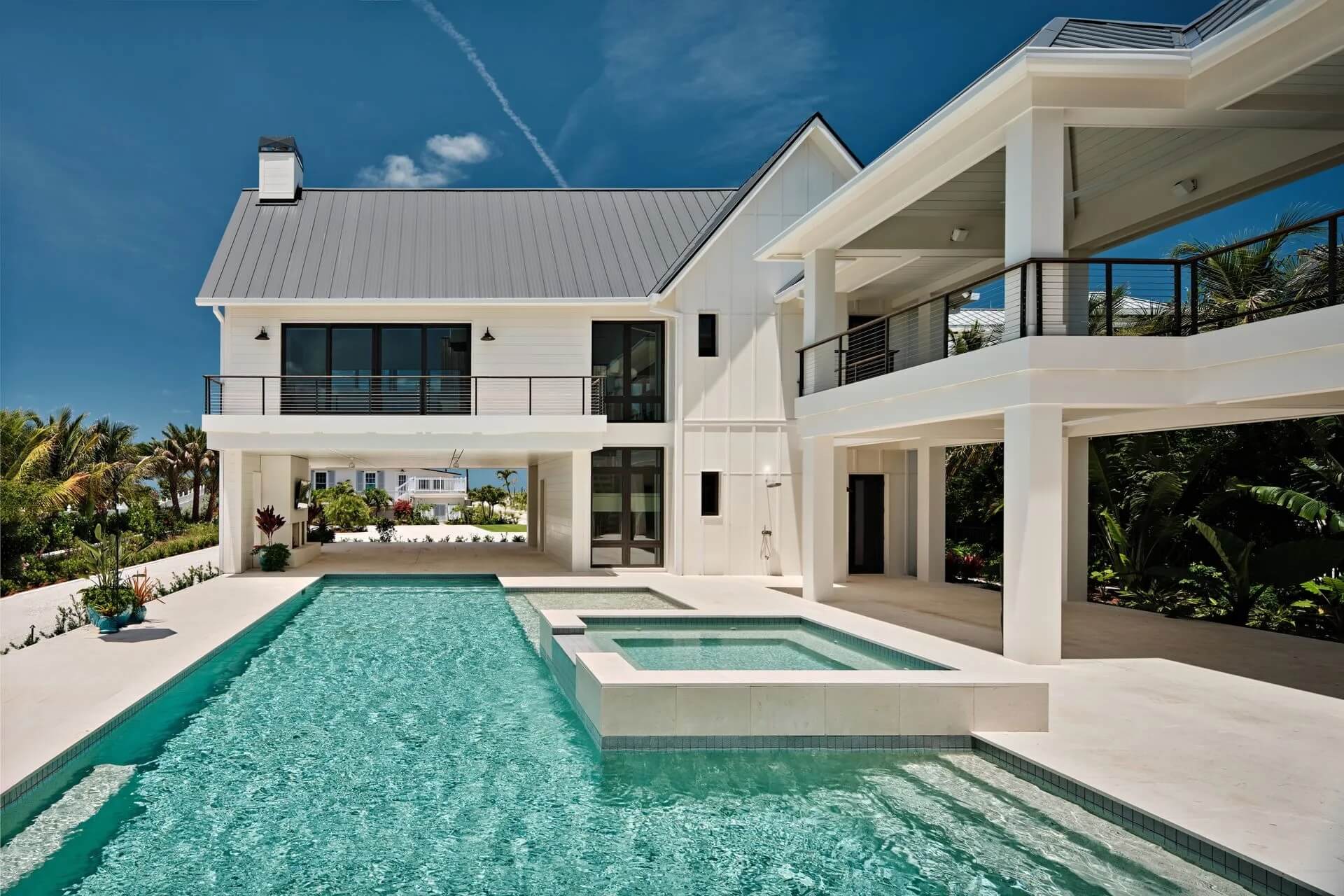
David Cramertag:architecture.nd.edu,2005:News/1828762026-07-06T14:55:00-04:002026-07-07T15:28:46-04:00Notre Dame architecture alumna Joyce Owens elected AIA president-electA 1958 Captiva Island cottage renovated by Owens in 2019, reworking the layout to open up ocean views while preserving the character of the original home.
Joyce Owens, FAIA, RIBA, B.Arch ’84, has been elected 2027 president-elect of the American Institute of Architects (AIA), positioning her to serve as AIA national president in 2028. Her election marks a significant milestone for the University of Notre Dame School of Architecture and for the profession at large. Owens becomes only the second Notre Dame graduate to lead the AIA, following Bill Bates, FAIA, B.Arch ’75, who served as AIA national president in 2019.
Joyce Owens, FAIA, RIBA, B.Arch '84, founding principal of Architecture Joyce Owens LLC (est. 2007), elected 2027 president-elect of the American Institute of Architects (AIA).
“Joyce Owens’ election as AIA president-elect is a moment of great pride for the Notre Dame School of Architecture and a testament to the enduring value of an architectural education grounded in tradition, civic responsibility, and service to the common good,” said Stefanos Polyzoides, Francis and Kathleen Rooney Dean of the School of Architecture and Professor. “Throughout her distinguished career, Joyce has demonstrated how architects can bring beauty, resilience, and humanity to the places where people live and work. Her leadership will bring a powerful and timely voice to the national profession.”
Owens described the moment as both a personal milestone and an opportunity to speak to the broader role architects play in shaping communities.
“Being elected AIA president-elect by my peers is an extraordinary honor, one I accept with deep gratitude and clear intention,” Owens said. “I feel my campaign message resonated because it articulated what architects know but have struggled to communicate: architects shape how people live, love, and work in their communities. Through design, we solve complex problems, blending creativity and technical expertise to address climate, culture, safety, resilience, and quality of life. Architecture goes far beyond buildings; it influences how communities function, recover, and thrive."
Owens traced that conviction back to her time at Notre Dame. Her third year abroad in the School's Rome Program, she said, first showed her that architecture was about more than design.
“My education at Notre Dame, particularly the transformative Rome Program, planted the seed that architecture is not isolated design, but holistic problems to be solved,” she said. “Decades later, I feel the public clearly does not understand what architects do. As AIA president in 2028, my commitment is to empower architects to tell their story and help the public understand what we do, why our work matters, and how we shape more adaptive, equitable, and thriving communities.”
Owens is the founding principal of Architecture Joyce Owens | Studio AJO, a Florida-based architecture and interiors firm she established in 2007. Internationally recognized for award-winning, climate-sensitive design, her work has focused especially on resilient coastal and island homes, resorts, and commercial projects. Before founding her U.S. practice, Owens was co-founding partner of Azman Owens Architects in London, where her clients included Boris Johnson, Alexander McQueen, and the Victoria and Albert Museum.
Sol Mates Guest House, Captiva Island, an example of the residential work that has defined Owens's Florida-based practice.
“Joyce’s influential work in shaping the future of coastal architecture illustrates a way toward a more resilient future,” said School of Architecture Prof. Sean Nohelty, AIA, B.Arch ’97. “As AIA president in 2028, her voice on a national stage will help restore reason, beauty, and trust in architecture. Joyce is the embodiment of the Notre Dame mission to be a force for good in the world through architecture and design. Her vision, passion, and leadership are especially needed at this time.”
The lobby of the Sanibel Captiva Trust Company, designed by Owens with a wood-vaulted ceiling and Tropical Bali–inspired interiors that blur the line between indoor and outdoor space.
Her election to one of the highest leadership roles in the architectural profession reflects a career defined by design excellence, professional service, and a commitment to architecture’s public value. It also underscores the enduring impact of a Notre Dame architectural education, one that prepares graduates not only to design buildings, but to shape communities, strengthen the profession, and lead with purpose.
“Joyce and I are the same generation of alumni—a generation of architects whose careers have witnessed transformative technological shifts and challenging environmental and social issues,” said Ron Henderson, FASLA, B.Arch ’85. “Joyce’s work draws from the lessons of Notre Dame—where our education deeply grounded us in contextual awareness and cultural literacy through our third year in Rome and our fourth year centered in Chicago. Her career has taken her to coastal communities where her design and technical leadership demonstrates that these Notre Dame lessons of equity and responsibility to the human condition prepared us for success working with unique people and places.”
The School of Architecture congratulates Owens on this extraordinary achievement and celebrates her continued leadership in advancing the discipline of architecture nationally and internationally. Owens will join the School of Architecture for the Fall 2026 Lecture Series on Sept. 30 at 5:15 p.m., for more information visit the event page.
]]>
McKenzie Lookebilltag:architecture.nd.edu,2005:News/1828812026-07-06T14:51:00-04:002026-07-06T14:55:18-04:00Notre Dame Arts Initiative awards over $400,000 for community and campus partners to lead inaugural Arts Biennial programming
The Notre Dame Arts Initiative has awarded 38 grants to foster sustained growth in the arts through partner programming for the inaugural Notre Dame Arts Biennial, scheduled for January through June of 2027. Awardees include 16 regional community partners, 19 campus units, and four Notre Dame Global locations, with another 60 campus units and external organizations involved as collaborators. In addition to funding, partners receive administrative support from Arts Initiative staff for planning, implementation, and promotion.
Projects include theatrical premieres, regional dance and music festivals, multimedia installations, visual art and architecture exhibitions, high-impact arts education programs, international artistic exchange, and more. Biennial programming is open to the public, and events will be held on Notre Dame’s campus, in and around South Bend, and at select global locations.
Occurring every two years, the biennial is an international arts festival rooted in the creative spirit, intellectual energy, and iconic traditions of Notre Dame and the region. Predominantly free programming across the visual, spatial, literary, and performing arts will contribute to the region’s long-term flourishing by enhancing quality-of-life and quality-of-place and by providing new platforms for arts research to positively impact the public.
In his inaugural address, University President Rev. Robert A. Dowd, C.S.C., urged the Notre Dame community to be builders of bridges to live out our mission as a leading global Catholic research university. The biennial is one of the most visible ways the Arts Initiative is responding to that call.
“This scale of coordination and collaboration is unprecedented,” said Michael Schreffler, director of the Notre Dame Arts Initiative. “We are grateful to all of our partners for bringing their energy and leadership to fully realize the vision of the biennial’s inaugural theme of symbiosis: a call to contemplate mutually-beneficial relationships through the arts and create them together in practice.”
Community partners leading biennial programming reflect the strength and diversity of arts and culture across the region. Participating regional community partners include:
Abby Marchesseault Dance Studio
Acting Ensemble
Equity in the Arts, an initiative of South Bend Venues Parks & Arts
Goshen College Music Center
Fischoff National Chamber Music Association
The History Museum
Lubeznik Center for the Arts
Merrimans’ Playhouse
New Industry Dance
Performing Media Festival, produced in partnership with IU South Bend
Saint Mary’s College, Department of Art
South Bend Civic Theatre
South Bend Community School Corporation
South Bend-Elkhart Regional Partnership
South Bend Museum of Art
South Bend Symphony Orchestra
Campus units awarded funding for partner programming similarly span artistic media and represent a University-wide commitment to interdisciplinary innovation. In addition to projects housed in arts departments, campus efforts are also being led by the College of Science, Hesburgh Libraries, the School of Architecture, and a range of interdisciplinary centers and institutes.
Beyond robust support for partner projects, the biennial also closes gaps in cultural access by attracting prominent artists to the region and making the highest-caliber arts experiences available to the public. In addition to world-class artists hosted by the Arts Initiative, signature performances, convenings, and exhibitions aligned with the biennial’s inaugural theme will be hosted by the DeBartolo Performing Arts Center, the Franco Family Institute for Liberal Arts and the Public Good, and the Raclin Murphy Museum of Art.
A dual emphasis on local and visiting artists is a hallmark of Notre Dame’s biennial. “We’re not aware of any other U.S. university currently curating a biennial of this nature and scale,” said Rebecca Struch, Arts Initiative managing director. “Establishing a groundbreaking biennial in northern Indiana, a place with an evolving but often overlooked arts scene, will advance the region as a global gathering place for arts and inquiry.”
The Arts Biennial launches at a pivotal moment for the arts across the region and on campus. Informed by its Catholic character, the University’s most recent strategic framework identifies the arts as a key priority and calls for deeper engagement with South Bend and the region. The South Bend-Elkhart region also recently adopted a new Arts & Culture Plan. The biennial builds on these developments by nurturing the arts as a shared community asset that strengthens social bonds and shapes place-based identities.
“The Notre Dame Arts Biennial reflects what’s possible when our community and local institutions work together,” said South Bend Mayor James Mueller. “This effort will activate our public spaces, support local artists, and strengthen the connections that make South Bend a vibrant place to work and live.”
Contact: Rebecca Struch, Arts Initiative managing director, 574-631-9845, rstruch@nd.edu
Originally published by Arts Initiative at arts.nd.edu on July 06, 2026.
]]>
Arts Initiativetag:architecture.nd.edu,2005:News/1820312026-05-26T11:56:00-04:002026-05-26T11:57:02-04:003D Printing their final project
Even with finals completed, the Architecture Library’s Makerspace is buzzing with activity in the week leading up to graduation.
Established in 2013, the Architecture Library Makerspace provides resources to students, faculty, and staff interested in anything three-dimensional, including modeling and printing.
The steady hum of 3D printers fills the space, producing one last creation for graduating architecture students, but it’s not a model for class or a critique. The finished piece — called a GradCap — is personal and will become part of their wardrobe as they enter Notre Dame Stadium for commencement and leave as alumni.
“A lot of what we print has some kind of value to the student,” Matthew Noffsinger, Architecture Library makerspace and graphics specialist, said. “It may be sentimental or something they’ve worked on throughout the semester. Some students will make prints related to their thesis or recreate a famous building in their hometowns. I think we even have a student doing a model of the Death Star this year.”
The tradition of attaching 3D models to architecture graduates’ caps goes back more than a decade. Going back even further with hand-created models. Noffsinger has helped students 3D print their GradCaps since joining the Architecture Library in 2024.
These final projects are a departure from the rigor and pressure of academic work. “It's a nice, fun thing we can do for them as they transition,” he said.
On the Monday before graduation weekend, the makerspace specialist already printed a dozen caps, had five additional requests in the queue, and expected more throughout the week.
Photo by Michael Caterina/University of Notre Dame
“There is a week until the ceremony, so we will have more come in,” he said. “We will probably be printing models and attaching them to caps an hour before the ceremony begins.”
Noffsinger already knows many of the students he is printing GradCaps for this spring. Most have taken the workshops he leads throughout the year. There, he introduces students to SketchUp, a 3D modeling software used for printing. While the workshops are open to anyone on campus, most fourth- and fifth-year architecture students sign up.
“A lot of them have no experience with 3D modeling,” he said. “I take pride in getting them from knowing nothing to being able to create something.”
Each GradCap takes approximately 24 hours to print, though the time can vary depending on the model’s size. As the printers hum inside the Makerspace, Noffsinger reflects on why he does this for the graduates.
“It makes me proud to make this accessible for them,” he said. “The GradCaps are something students are excited about, and they make them stand out. They’re using skills they’ve developed during their time here for fun, but it is also a skill set they’ll use in the future.”
]]>
Becky Malewitztag:architecture.nd.edu,2005:News/1816512026-05-12T13:01:00-04:002026-07-06T15:11:23-04:00University awards recognize Notre Dame faculty excellenceAssociate Teaching Prof. Giuseppe Mazzone awarded the 2026 Thomas P. Madden Award.
“This year’s faculty award recipients represent the very best of Notre Dame through their outstanding achievements in teaching, scholarship, and service,” McGreevy said. “Their work strengthens our academic community and furthers the University’s mission as a leading global Catholic research institution.”
Associate Teaching Prof. Giuseppe Mazzone was awarded the Thomas P. Madden Award. The citation reads:
The Thomas P. Madden Award honors a faculty member who has demonstrated exceptional leadership in the teaching of first-year students. Giuseppe Mazzone leads courses where students in the School of Architecture form their earliest habits of seeing, making, and thinking as designers, including Graphics I: Drawings and Design I. He builds high-clarity instructional structures that help first-year students translate abstract principles into disciplined craft. His teaching is grounded in fundamentals while also helping students develop confidence moving between analog and digital tools in a coherent, “traditional approach to digital technologies.” In 2018, he developed a detailed graphic reconstruction of the Parthenon West Frieze specifically as an instructional tool for helping freshman studio students learn how to cast shades and shadows—an example of faculty leadership that turns scholarly skill into actionable pedagogy. Professor Mazzone consistently sets expectations that are demanding but legible, enabling students to build competence through repeatable steps rather than guesswork. His pedagogy reflects a disciplined studio ethos that first-year students can carry forward—training attention, accuracy, and judgment—while keeping the learning process accessible through concrete exercises and visual tools.
Coordinated by the Office of the Provost, the annual University faculty awards recognize excellence in research, teaching, and service to the University; signal milestone accomplishments and contributions across the disciplines; and celebrate outstanding members of the Notre Dame community.
Learn more about the awards and read the citations for this year's winners at provost.nd.edu/awards.
Originally published by Emily Monacelli Guzman at provost.nd.edu on May 12, 2026.
]]>
Emily Monacelli Guzmantag:architecture.nd.edu,2005:News/1796472026-03-02T15:45:00-05:002026-03-02T15:46:02-05:00The one thing you should know about Notre Dame Mumbai
Every month in 2026, Notre Dame Global will feature one of the 12 locations on its website—asking each director to share with us “the one thing” they want the Notre Dame community to know about their programs, their achievements, their goals, or their aspirations.
What is the one thing you want the Notre Dame community to know about Notre Dame Mumbai?
"We are a strategic platform for engagement with India—often, a catalyst first and then a sustained presence that engages with Indian institutions across sectors."
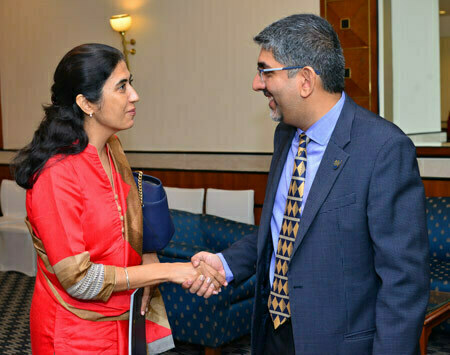
Dhiraj Mehra, director of Notre Dame Mumbai, welcomes a guest to a provost reception in India
DHIRAJ MEHRA: Notre Dame Mumbai serves as a strategic platform for engagement with India, positioning the University within one of the world’s most important global geographies. Not only do we have a presence in India, we have a sustained institutional presence—one that advances research, teaching, and public-interest engagement in partnership with Indian institutions across a myriad of sectors. These partnerships are often multi-year collaborations that lead to knowledge that is relevant, rigorous, policy-oriented, and grounded in the reality that is India.
An excellent example is Notre Dame Mumbai’s participation in Project Sampoorna, a signature educational and anti-poverty initiative within Notre Dame’s Global Center for the Development of the Whole Child. Since 2021, Project Sampoorna has introduced a transformative Whole Child Development curriculum into the state of Telangana’s residential schools, now serving 270,000 of India’s most vulnerable and marginalized children.
Notre Dame Mumbai’s involvement began by simply responding to a request for help with constructing a budget for a pilot project, but we became contributors even at the beginning—identifying stakeholders, working alongside Neil Boothby’s team to envision the project, assisting with the hiring process, and helping to launch the initiative. And, we have stayed involved by providing strategic guidance, facilitating institutional connections, managing talent of the project team, and monitoring impact and alignment to the University’s strategic framework.
In other spheres as well, we are focused on long-term institutional partnerships. This past December, we invited a strategic cross-section of Indian higher education institutions to campus to jumpstart and enhance partnerships, both in India and at Notre Dame. This was a great step forward as we work for even greater sustained involvement and two-way mobility between the University and India.
Why is that one thing—being a strategic platform for engagement with India—so important to Notre Dame Mumbai?
"As does the University as a whole, we aspire to be a convenor of global dialogues."
DHIRAJ MEHRA: As we dedicate ourselves to the University’s mission to be a convenor of global dialogues, we are inspired by the knowledge that the dialogues we convene at Notre Dame Mumbai take place in a country that, with 1.4 billion people and counting, is the most populous in the world. Even more importantly, India brings into focus many of the defining challenges and opportunities of the 21st century—rapid urbanization, infrastructure development, and climate challenges and resilience—with some of the world’s most complex societal challenges.
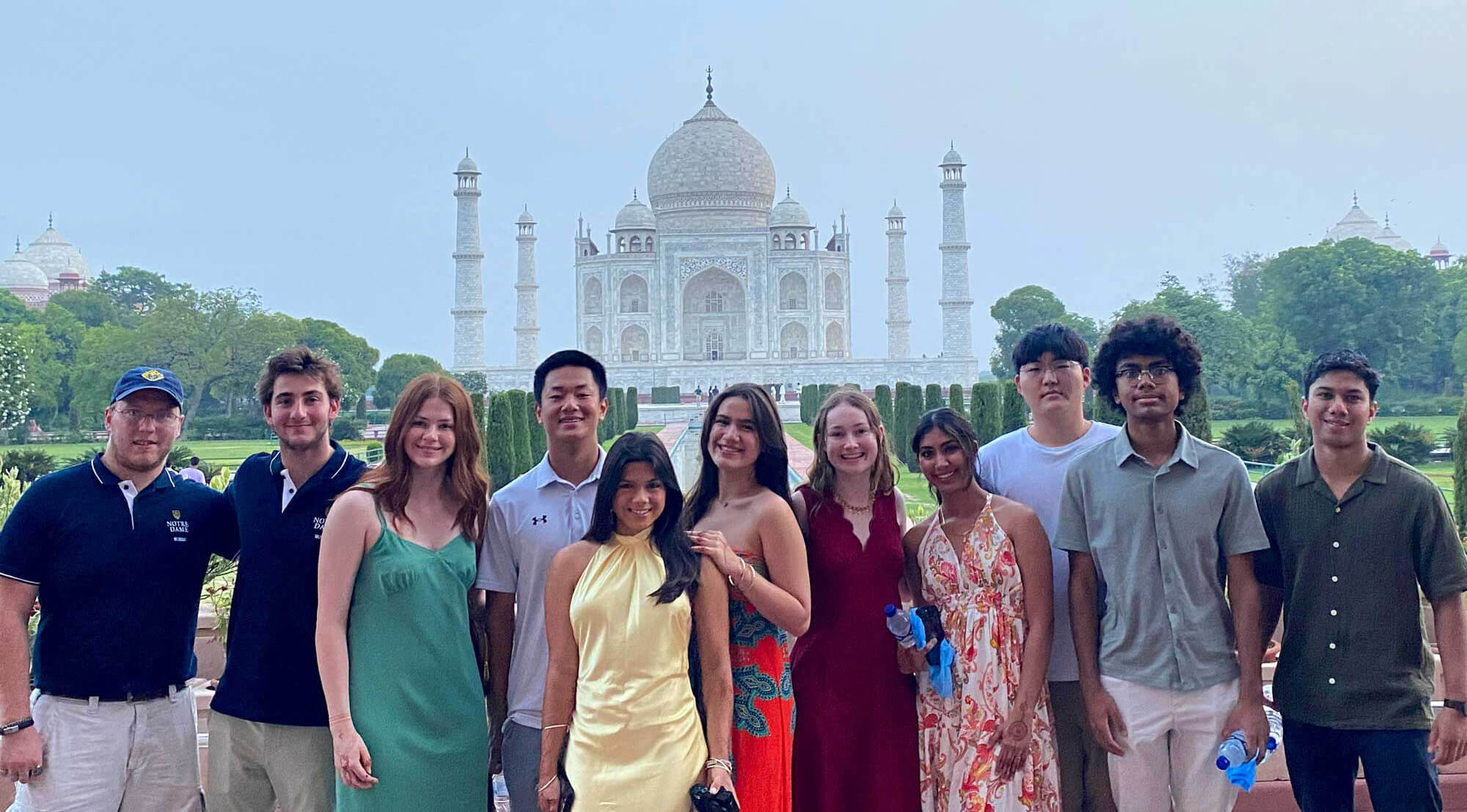
Notre Dame India Summer Program students visit the Taj Mahal, led by Hayden Mascarenhas (far right), Programs and Communications Consultant for Notre Dame Mumbai
It is to immerse themselves in this environment and to explore these complex challenges that undergraduates choose Notre Dame Mumbai’s semester-long or summer programs and internships, like those offered through the Global Professional Experience program, in the liberal arts, science, business, or medicine.
Faculty come here to engage with India’s top scholars and to perform research in a number of fields. A notable example is the collaboration between Notre Dame School of Architecture professor Krupali Krusche and Indian archeologists using 3D documentation and advanced mapping techniques at the Taj Mahal, a World Heritage site.
And, just recently, several parts of the University coalesced when—on Notre Dame’s home campus, in Mumbai, and in Pune—we were integral to a dialogue among students, journalists, scientists, and artists on one epic question: the beginnings of the universe. The initiative began with Notre Dame Global’s Notre Dame Asia Guest Scholar/Artist Partnership Program and melded the insights of Notre Dame Chemistry and Biochemistry Assistant Professor Saurja DasGupta as well as the cancer researcher-turned-comics artist Argha Manna, a faculty member at the Indian Institute of Technology (IIT) Gandhinagar.
What does this one thing reveal about India?
"India is a central actor in the global knowledge, policy, and innovation ecosystem, with the added benefit that many at Notre Dame find great resonance in the spirituality that pervades the country."
DHIRAJ MEHRA: The future of global higher education and research depends on moving beyond transactional internationalization and toward institutionalized, values-driven partnerships with strategically important countries. Notre Dame Mumbai’s accomplishments, strategies, and aspirations emphasize that India is such a country. It is a central actor in the global knowledge, policy, and innovation ecosystem.
Additionally, it is important to acknowledge the spirituality that shapes life in India and its alignment with the spirituality so integral to Notre Dame. When students and faculty immerse themselves in India, they often find their own faith deepening.
One example is the experience of Ty Harrington ’26, who came to India for two consecutive summers and found the experience transformative. He encourages classmates to approach India with intention and openness. “Reflect deeply on why you want to go…It is an intense adjustment and will require periods of adaptation. If you decide to go, be radically open. Do not treat it like a box to check. Go because you believe India has something to teach you, and you are willing to listen.”
Learn more about the work of Notre Dame Mumbai and the University of Notre Dame’s global network, or browse related articles:
Learn more about the collaborative work of Notre Dame Mumbai
Project Sampoorna
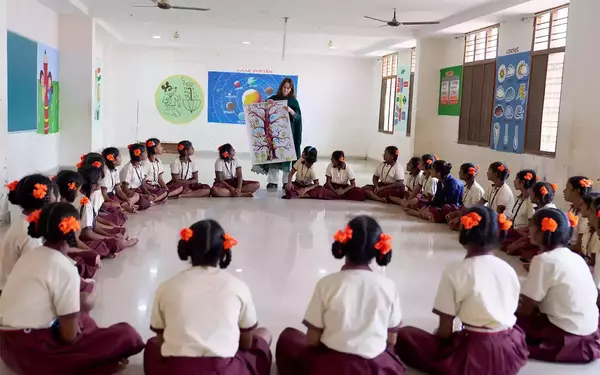
As part of the Project Sampoorna curriculum, children look at a poster of cartoon-like characters depicting various emotions and choose the one they identified with at that moment, to help them learn to articulate their feelings and develop empathetic listening skills.
Project Sampoorna was launched in the residential schools of the Indian state of Telangana—schools run by the Telangana Tribal Welfare Residential Educational Institutions Society that house and teach some of India’s poorest and most marginalized children. The curriculum embeds academics in a culture that prioritizes the nutritional and psychosocial needs of students, with an emphasis on collaboration, critical thinking, empathy, and kindness.
So successful has Project Sampoorna been in its embrace by teachers, students, and administrators that, from a pilot program introduced directly after the pandemic in 16 schools, it was scaled up to about 100 schools in just two years. Now, its curriculum has been integrated into the Bachelor of Education programs at Osmania University, and plans are being developed to introduce the curriculum throughout India.
For one undergraduate, summer study in India became a journey of spiritual clarity
For Andrew Volpe, a global affairs and Chinese major from Chapel Hill, North Carolina, the India Summer Program in 2025 proved to be more than a cultural immersion. It became a journey of spiritual clarity.
On Day 2 of his program, a jet-lagged Volpe decided to attend 6 a.m. Mass at the Cathedral of the Holy Name, which led to breakfast with Cathedral priests, and then to both a deep friendship and an enrichment of his Catholic faith.
“Even in a place where Catholics are few, the Church felt like home,” Volpe observed. “The universality of it hit me more in India than anywhere else.”
An innovative collaboration between a Notre Dame scientist and an Indian comic-book artist leads to public dialogue in the US and India on an epic question: the origins of the universe
Together, they explore in scientific and public forums the chemical origins of life, examining how simple molecules on early Earth may have assembled into increasingly complex systems capable of supporting life. First in talks at Notre Dame and at other American universities, and then in Mumbai and Pune, they have worked together to make science accessible and to emphasize the importance of uncertainty, experimentation, and imagination as key drivers of scientific progress.
Originally published by Mary Hendriksen at global.nd.edu on February 27, 2026.
]]>
Mary Hendriksentag:architecture.nd.edu,2005:News/1794842026-02-24T10:40:00-05:002026-03-03T10:03:33-05:00Notre Dame Architecture Takes the Lead at Isthmia: Professor Alessandro Pierattini Advances Greek Temple Research
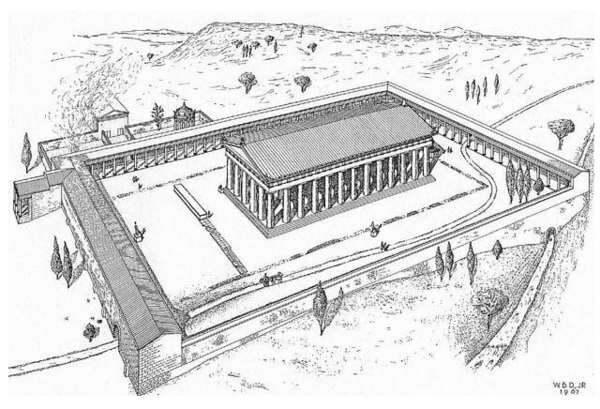
Summer 2025 marked a major milestone for classical archaeology at the University of Notre Dame as Associate Professor Alessandro Pierattini assumed leadership as the director of excavations at Isthmia, one of the four great Panhellenic sanctuaries of ancient Greece. With this appointment, the project officially became the University of Notre Dame Excavations at Isthmia with support from the Notre Dame Research team.
“This represents an important milestone,” said Pierattini. “Notre Dame now leads one of the most historically significant archaeological sites in Greece, joining a select group of American universities entrusted with directing major excavations in the country. This enhances the University’s reputation for excellence in teaching, research, and global engagement.”
Archaeological investigations have been ongoing since 1952, and our new stewardship places Notre Dame at the center of an internationally recognized, legacy project in classical archaeology, Pierattini said.
Isthmia was home to the sanctuary of Poseidon, where the Isthmian Games, second only to the Olympic Games, were celebrated. The site also played a pivotal political role, in BC 336, when Alexander the Great secured his leadership of the Greek alliance for the campaign against Persia.
For Pierattini, the work at Isthmia connects directly with his broader research into how Greek temples evolved. His 2022 book, The Origins of Greek Temple Architecture, published by Cambridge University Press, reconstructs how Greek temples developed between the end of the Bronze Age and the early Archaic period, roughly from the eleventh to the mid-seventh century BCE.
Speaking from his office in Walsh Family Hall of Architecture, Pierattini describes the motivation behind the book. “Most histories of Greek architecture began with the temple already formed, or addressed its formative period only briefly, leaving the narrative inadequately integrated with the expanding body of archaeological evidence for this critical phase of Greek history” he said.
“I wanted to understand how the Greek temple became the monument we all admire. In other words, there was a missing chapter in the history of classical architecture — the prequel.”
Rendering of the sanctuary as it may have looked in the Roman Period.
Rather than searching for a single “origin” of the temple, the book traces a long process of transformation. Pierattini analyzes early Greek temples in terms of their function, design, materials, construction, and appearance, showing how these aspects changed over time and from place to place. Building on earlier scholarship, especially the work of J. J. Coulton, including the famous study of the Toumba Building at Lefkandi, he proposes a broader and more integrated picture. His contribution lies not in isolating one prototype, but in explaining how and why temples gradually became monumental through a series of local experiments and innovations.
One of the book’s key points is that early Greek temples were not simply “primitive” versions of later ones. They were fully meaningful buildings in their own cultural contexts, even when made of wood, mudbrick, and thatch. Over time, however, social, political, and economic changes reshaped Greek communities. Growing populations, expanding networks of exchange, and new forms of competition and display all played a role in encouraging more ambitious building projects.
“People gained social prestige in proportion to what they dedicated to the gods,” Pierattini explains. “This competition in giving led to greater investment in religious buildings.”
Materials played a decisive role in changing how temples looked and worked. In the early phases, roofs were typically thatched and steeply pitched. When terracotta roof tiles were introduced in the seventh century BCE, everything changed.
“The shift from thatch to tile didn’t just make buildings more durable,” Pierattini notes. “It fundamentally altered their appearance and their architectural logic.”
Together, these efforts highlight both the enduring cultural importance of ancient architecture and, for the Notre Dame School of Architecture, this research also speaks directly to the study of the classical tradition, not as something that appeared fully formed, but as the result of centuries of experimentation, adaptation, and creative problem-solving.
“Our first campaign under the University’s name was highly successful, supported by a grant from the Replogle Foundation and with generous support from the ND Office of Research. We advanced research on the Archaic Temple of Poseidon, documented significant new evidence, and provided transformative field experience for Notre Dame undergraduates, who participated as research interns in Greece. This combination of hands-on learning, cultural immersion, and groundbreaking scholarship reflects the University’s mission to integrate teaching and research at the highest level,” he said.
Looking ahead, Pierattini’s scholarship continues to expand. Upcoming publications include:
A new monograph on the Archaic Temple of Poseidon at Isthmia, one of the earliest Greek stone temples.
A new architectural study of the Toumba Building at Lefkandi (10th century BCE), a key monument for understanding early Greek architecture.
A collaborative architectural study of the Temple of Jupiter Optimus Maximus on the Capitoline Hill in Rome.
Co-authors:
Charles Ghati, MSHP ’25, and Lisa Bukhala ’25
]]>
Lisa Bukhala '25tag:architecture.nd.edu,2005:News/1789732026-02-04T17:18:00-05:002026-02-05T10:07:54-05:00Building Faith in Ice: Architecture, Community, and Lessons Beyond the Studio
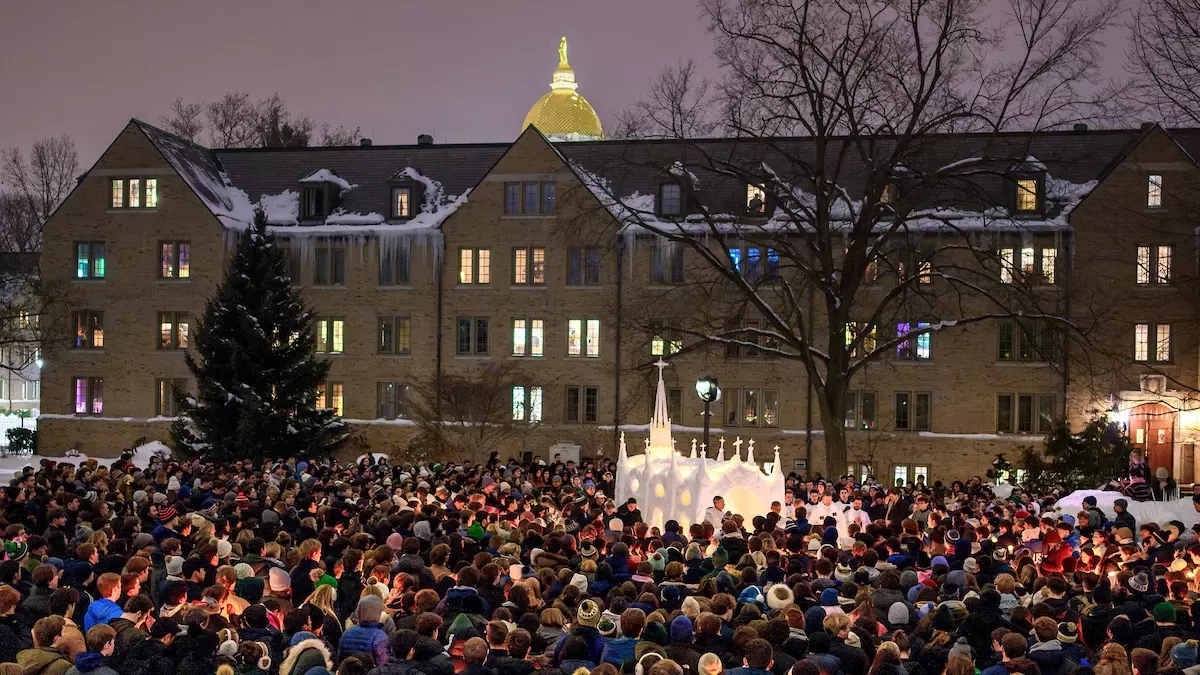
On a frozen stretch of the North Quad, what began as a fun winter construction experiment grew into something far more meaningful: a student-built ice chapel that drew thousands into prayer, community, and shared wonder. For Wesley Buonerba ’27, School of Architecture at the University of Notre Dame, the project became a powerful lesson in how architecture shapes human experience far beyond the classroom.
The idea emerged after Buonerba and Martin Soros ’26, a civil engineering major, watched fellow Coyle Community resident Liam Devine ’28, build an igloo on the quad several weeks earlier. All three students live in Zahm Hall. Inspired by the igloo, Buonerba and Soros decided to take on a snow and ice project of their own and their first instinct was immediate.
“Let’s build a chapel,” Buonerba recalls. And the St. Olaf Ice Chapel was conceived.
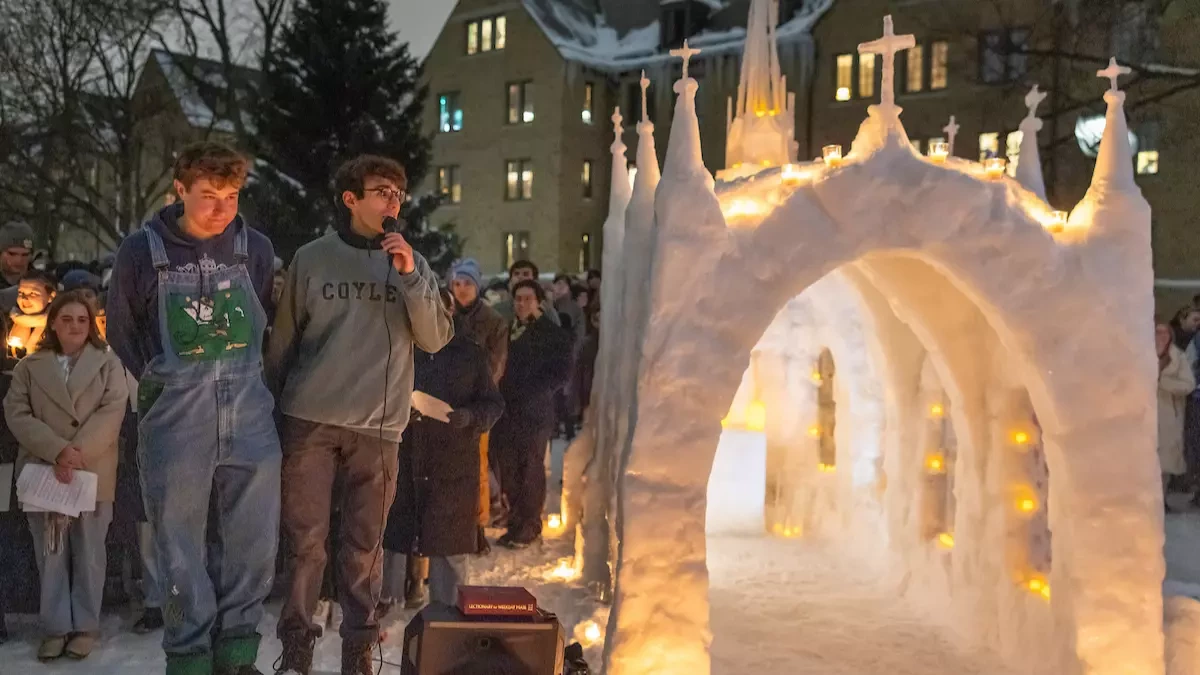
Wesley Buonerba ’27 and Martin Soros ’26 address the crowd in front of St. Olaf Ice Chapel.
The decision was personal as well as communal. Buonerba, raised Catholic, says sacred architecture has long been central to why he chose to study at Notre Dame.
“This University’s Catholic identity is such a core part of campus life,” he said. “At first it was just something fun to try, but as we kept building, we realized it could be a great way of evangelization and showcase our Catholic identity."
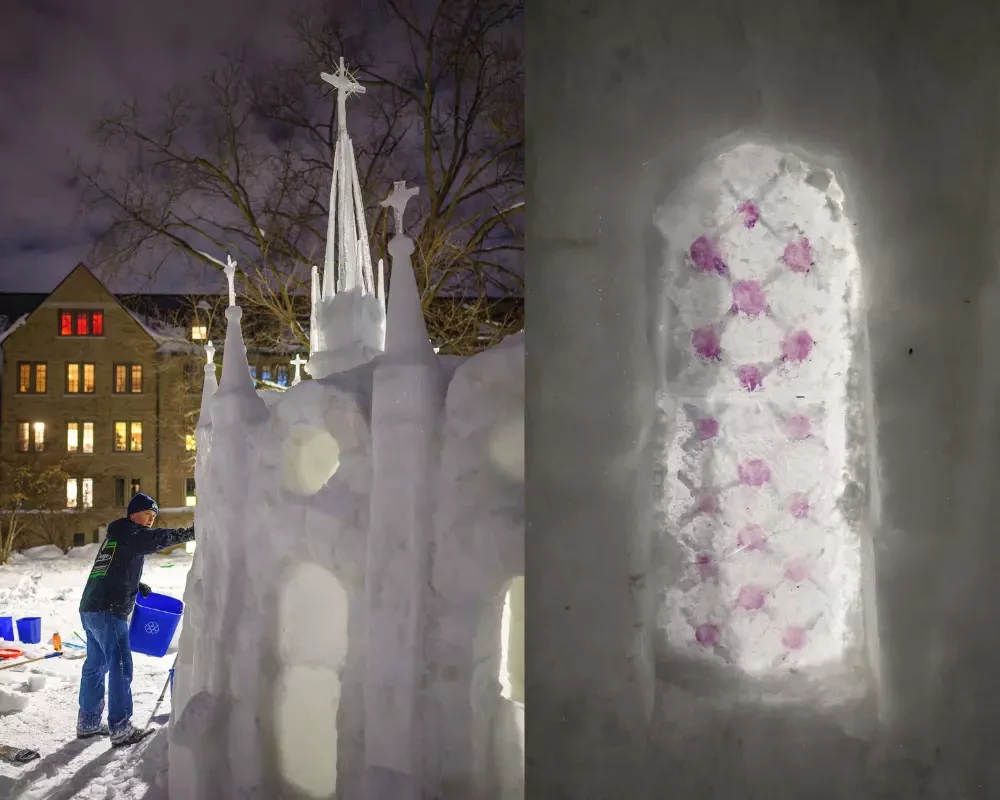
Buonerba’s architectural influences soon began to shape the chapel’s design. His time studying in Rome, at the School of Architecture’s campus, deepened his love for sacred architecture, while French Gothic precedents, especially Sainte-Chapelle in Paris, served as a central inspiration for this project.
“In my mind, we were making a mini Sainte-Chapelle or that’s the idea,” he said with a laugh.
Their plan was simple: armed with a measuring tape and two sheets of paper bearing rough sketches, they mapped out a series of arches and how the vaults would connect, marked the layout on the ground, and began setting the blocks in place.
“We just went for it with lessons learned from taking classes like Building Technology and Structures,” he said.
Though constructed from snow and ice, Buonerba, Soros, and a core group of friends, approached the design like a masonry building with arches where they used a car hood they found in the basement of their dorm as formwork to hold the voussoirs as they were placing the keystone and making it sit using a slashy mortar made from snow and water.
“It was a lot of trial and error,” Buonerba explains. “We were just making blocks and putting them together like you would a stone building using Gothic architecture.”
Working with ice and snow led him to reflect on materials and construction. “If we were able to build this in six days, why can’t we build structures today that are both beautiful and structurally sound? Why can’t we build to last?” he said.
Even before the Mass was celebrated, the chapel was already changing campus life. As they worked on the North Quad, often in bitter, painful cold in subzero temperatures, they began noticing how much joy the project brought to people passing by. Located along a busy route to North Quad and the North Dining Hall, the site saw constant foot traffic between classes. Students frequently stopped to smile, take photos, and explore the structure, and seeing that sense of curiosity and delight made the effort feel worthwhile, Buonerba said.
The project also reinforced an important lesson about collaboration. Working alongside Soros and volunteers from different majors showed Buonerba how essential hands-on teamwork and collaboration is to architecture.
“You can’t just step back and let others do the work,” he said. “Everyone had a role, making blocks, building buttresses, setting the spire and collecting the icicles for all that. I wasn’t the main guy; I was just one of them guiding things along.”
When thousands braved the cold to attend the Mass on February 2, 2026, Buonerba said it deepened his appreciation for Notre Dame’s community and how much could be accomplished on short notice to celebrate Candlemas, the Feast of the Presentation. A friend quickly assembled a choir the day before, students helped shovel snow across North Quad so worshippers would not be standing in ankle deep snow, and even a borrowed karaoke speaker from a nearby dorm helped make the service possible.
“An estimated crowd of 1,800 to 2,000 people gathered for Mass at St. Olaf Ice Chapel,” said Rev. Richard Bullene, C.S.C., assistant dean, academic director of the Rome Studies Program, and associate teaching professor. “Although 1,600 Communion hosts had been prepared, ministers began breaking some in half toward the end of the service to accommodate the unexpectedly large turnout.”
He added that the chapel and Mass quickly became a major topic of conversation at Corby Hall, which is the center of community life, common prayer, and shared meals for the Priests and Brothers of Holy Cross community on campus.
“Saint Olaf Chapel and the Mass have been the top table topic in Corby Hall these last few days. The construction, the creativity of the structure, and the spontaneous response to a campus Mass all bring up that familiar phrase: ‘Only at Notre Dame…’ ” he said.
The experience has strengthened Buonerba’s desire to pursue architecture that directly serves communities. This summer, he will travel to Mombasa, Kenya, through Notre Dame’s Center for Social Concerns, helping construct housing and supporting vocational training efforts for the local communities.
“I prefer being hands-on,” he said. “Getting to build and see the impact right away.”
Long after the chapel melts, the lessons remain, about beauty, collaboration, faith, and architecture’s power to shape moments of shared meaning.
For Buonerba, the project proved something fundamental and he gave all the glory to God.
“Architecture,” he said, “is art on a large scale. And it can really inspire people.”
]]>
Lisa Bukhala '25tag:architecture.nd.edu,2005:News/1787492026-01-28T11:00:00-05:002026-02-20T13:24:10-05:00John Simpson named 2026 Richard H. Driehaus Prize Winner; Philippe Villeneuve to receive Henry Hope Reed AwardArchitect John Simpson led the “More Music” redevelopment of the Royal College of Music in London.
In honor of his lifelong dedication to and outstanding achievements in traditional urbanism and architecture, John Simpson has been selected as the 2026 laureate of the Richard H. Driehaus Prize at the University of Notre Dame. He will receive the prize during a ceremony on March 21 at the Murphy Auditorium in Chicago.
A native of the United Kingdom, Simpson first gained prominence in 1990 during the Paternoster Square development competition in London where he advocated for New Traditional Architecture and Urbanism. The Driehaus Prize citation notes that “his inspiring leadership in gathering a distinguished group of his peers to address what was then a major civic challenge was clearly noticed.”
While the project was eventually realized with a different vision, Simpson’s proposal “highlighted an emerging, new and constructive approach to urban regeneration and cemented his influence as one of the earliest proponents of modern classicism,” the citation states.
“Our ancestors built wonderful and enduring cities through a shared tradition,” Simpson said. “When I began my career, there were only a few that held to that path. It is such a joy to see how this has changed over the years with a rising generation of architects committed to restoring the continuity that binds us to our Classical roots and determined to create a beautiful and humane world for future generations to enjoy. This award recognizes the enduring value of tradition, not as nostalgia, but as a foundation for building well and responsibly today.”
Simpson’s work has been extensive and deeply influential, the prize jury wrote. It has unfolded through private, public and institutional commissions, “each executed with a keen eye for a balance between precedent based composition, place-appropriate siting and a focus on durability of construction.”
Walsh Family Hall of Architecture (Photo by Matt Cashore/University of Notre Dame)
“While thoughtfully contextual with respect to local character and scale, his work also stands as a testament to the multiple building cultures that make up all traditions and offers solutions to the critical need for variety and uniqueness of place facing the built environment,” the citation continued. “Chief among his projects deserving praise are the King’s Gallery at Buckingham Palace, his many projects at Poundbury for the Duchy of Cornwall, the DMRC Rehabilitation Facility at Stanford Hall, the Royal College of Music in London, the School of Architecture at the University of Notre Dame and his educational projects at Eton, Oxford and Cambridge.”
The jury also recognized Simpson’s long interest in teaching, both informally through his practice and often didactic architecture and through formal teaching positions at the Prince’s Foundation, the University of Buckingham and, most recently, at Cambridge University at the Center for the Study of Classical Architecture. Simpson is also a fellow at Gonville and Caius College, Cambridge.
“John Simpson has long maintained that traditional forms are environmentally sound and contribute to the sense of local identity. His work amply illustrates that the practice of traditional urbanism and architecture does indeed facilitate the bonds of community by encouraging people of all kinds to share a common, living culture of building and to avail themselves of the opportunity to identify with, live and flourish in its distinctive presence,” said Stefanos Polyzoides, Driehaus Prize jury chair and the Francis and Kathleen Rooney Dean of the School of Architecture.
Philippe Villeneuve, chief architect for historical monuments in France
In conjunction with the Driehaus Prize, the 2026 Henry Hope Reed Award will be given to Philippe Villeneuve, a French architect specializing in historic monument conservation and restoration. Villeneuve was selected for his visionary leadership in the restoration of the Cathedral of Notre-Dame in Paris after a 2019 fire.
Villeneuve, who studied architecture at the École d’Architecture de Paris-Conflans, obtained his governmental architectural diploma in 1989 and later a diploma from the École de Chaillot. In 1997, he passed the “Thèse de Concours” to become chief architect for historical monuments in France. He has worked on restoration projects including the Angoulême Cathedral , the chevet and north portal of Limoges Cathedral and the Hôtel de Ville in La Rochelle.
“Villeneuve’s crowning achievement has been in bringing the Notre-Dame Cathedral in Paris from the brink of collapse to its rightful place as the most significant building in France and one of the most recognizable in the world,” Polyzoides said. “Thanks to Villeneuve, the iconic cathedral — an edifice expressing the spiritual essence, technical prowess and proud identity of the French nation across the centuries — was reconstructed in accordance with its original 12th century form.”
Villeneuve engaged hundreds of architects, engineers, designers and craftspeople from across France and looked to the original sources of materials to rebuild the structure. His expansive team combined traditional and cutting-edge construction techniques in tandem to execute the reconstruction in record time.
The jury cited Villeneuve’s leadership in advocating that Notre-Dame de Paris be rebuilt in its original construction methods and returned to its original form.
Interior of the Cathedral of Notre-Dame de Paris (Photo by Nikada/iStock)
“Challenging the preservation protocols in place and the high-tech visions of popular architects, Villeneuve argued instead that historic buildings possess physical integrity, community values and symbolic meaning. He had the courage to take his case to French President Emmanuel Macron to explain his viewpoints, thereby convincing the president despite strong opposition,” the jury citation reads.
This year’s Driehaus Prize and Henry Hope Reed laureates were selected by a jury composed of Ben Bolgar, executive director of the Kings Foundation, London; Melissa DelVecchio, partner at Robert A.M. Stern Architects, New York; Michael Lykoudis, professor emeritus of architecture at the University of Notre Dame; Demetri Porphyrios, founding principal of Porphyrios Associates, London; and Julia Treese, partner at Treese Architekten, Berlin and Munich. Polyzoides, also a partner at Moule & Polyzoides, Architects and Urbanists, Pasadena, California, served as jury chair.
The $200,000 Driehaus Prize is the largest cash award given in architecture worldwide. It is granted to architects by the Driehaus Trust, in the name of Richard H. Driehaus, founder and chairman of Chicago-based Driehaus Capital Management LLC, for their excellence in the design of New Traditional Architecture and Urbanism over their entire career. The Henry Hope Reed Award of $50,000 is similarly granted to individuals who have contributed to the design and building culture that cultivates the traditional city, its architecture and art through writing, planning or promotion.
Contact: Carrie Gates, associate director of media relations, c.gates@nd.edu or 574-993-9220
Originally published by Carrie Rulli at news.nd.edu on January 28, 2026.
]]>
Carrie Rullitag:architecture.nd.edu,2005:News/1787452026-01-28T10:44:00-05:002026-01-28T10:45:23-05:00School of Architecture’s Ming Hu Wins the 2026 AIA/ACSA Practice and Leadership Award
The American Institute of Architects (AIA) and the Association of Collegiate Schools of Architecture (ACSA) selected the project, From Studio to Systems: A Research-Based Model for Architectural Education, by Ming Hu, associate dean for research, scholarship and creative work in Notre Dame’s school of architecture, as the winner of the 2026 AIA/ACSA Practice and Leadership Award. This national award, which is jointly sponsored by the AIA and ACSA, honors exemplary models of teaching, scholarship, and outreach that demonstrate leadership and sustained impact on architectural education and professional practice.
The award emphasizes excellence in preparing students for real world practice and leadership.
“I’m sincerely grateful for this recognition and I see it very much as a reflection of the School’s broader commitment to research-informed pedagogy, experimentation and meaningful engagement with practice. The intellectual environment, encouragement and institutional support provided by the School have been essential in allowing this pedagogical work to take shape and ultimately be recognized at a national level” Hu said.
The project presents a reimagined model of architectural education that replaces traditional, form-driven studio pedagogy with interdisciplinary, research-based, and practice-engaged learning. Developed at the University of Notre Dame, this approach addresses critical gaps identified in the 2023 ACSA white paper, including the lack of standardized pedagogies and limited student exposure to real-world stakeholders and data-driven methods, according to the project description.
Guided by three central questions, the model introduces new course formats and collaborative frameworks. Architecture students are embedded within interdisciplinary teams alongside engineers, real estate professionals, and environmental scientists to solve sustainability challenges at both building and urban scales. Courses such as ARCH 43611: Carbon Neutral Development and SU25-34500: Real Estate and Sustainable Development emphasize real-world decision-making, while ARCH 81153: Adaptive Reuse Studio turns the graduate studio into a data-rich research lab.
A peer-reviewed journal article on this research-based pedagogical approach is scheduled for publication in Discovery Sustainability early this year, further extending the School’s impact in architectural education.
“I feel very lucky to have co-taught with amazing faculty across the campus, Jennifer Tank, Diogo Bolster,Alex Hardy, Brett Peter, Eugenio Acosta; worked with brilliant students, and collaborated with passionate staff and friends from the Notre Dame Office of Digital Learning, KC Frye, Adam Heat, and Jacob Mathis,” she added.
]]>
Carrie Rullitag:architecture.nd.edu,2005:News/1780842025-12-18T11:25:00-05:002025-12-18T11:30:09-05:00Sacred Preservation
Architecture School Students and Faculty Bring Ruined Medieval Italian Church Back to Life
During their Fall 2024 semester study in Rome, second-year Master of Science in Historic Preservation (MSHP) students were led by Professor Paolo Vitti, David P. Manfredi Professor of the Practice, on a preservation project in the island of Sardinia. The studio focused on documenting and creating a conservation strategy for the ruined historic church of Sant’Andrea in the town of Orani, originally built in the early 16th century. With the guidance of Professor Selena Anders and the aid of professionals from the University of Cagliari, the students surveyed the existing conditions at the site, created a digital record of the ruined structure and proposed a reconstruction plan. Earlier this year, the Sant’Andrea project drew an unprecedented $1 million reconstruction gift from the Regional Government of Sardinia.
“This would not have been possible without the sponsorship of the Michael Christopher Duda Center for Preservation, Resilience, and Sustainability and the dedication of our students and faculty. Restoring neglected historic churches is a way to reconnect local communities with their spiritual roots, reactivate local traditional practices in architecture and construction and encourage local economic development. The powerful message that Notre Dame’s Historic Preservation Program conveyed to the Municipality of Orani has already had a broader impact. The learning method followed in the Sant Andrea project is being used as a model to launch a School of Advanced Training in Preservation there, with a focus on heritage preservation and reconstruction in Sardinia”. Vitti said.
The success of our Preservation, Resilience and Sustainability program has spawned further opportunities for our students in the study and reconstruction of projects during their semester of study in Europe. The third forthcoming such studio effort will select a church in Burgundy, France in the fall of 2026.
]]>
Carrie Rullitag:architecture.nd.edu,2005:News/1769522025-12-02T12:23:00-05:002025-12-02T12:24:38-05:00Fighting for Community RegenerationChristopher Harris, the executive director of redevelopment for the city of Gary.
Christopher Harris is a fourth-generation resident of Gary, Indiana. He traces his family roots to the Great Migration of African American families from the American South to northern cities like Gary. Stories passed down from his great-grandfather talked about Gary as a great melting pot of cultures, ethnicities, and opportunities. Two generations later, Harris's father remembered Gary as vibrant. He recalled days shopping downtown, evenings spent at the Palace Theatre, parades down Broadway.
But Harris, now the executive director of redevelopment for the city of Gary, doesn't share those memories. The Gary he remembers can't be described as anything resembling vibrant.
“I always was very fascinated as a child, hearing the stories of having such a completely different life experience than my father,” he said. “Within a short period of time, between five to 10 years, downtown was really turned on its head when it came to being a symbol of blight as opposed to a symbol of economic prosperity.”
The rise and fall of the Steel City
Gary, Indiana, was founded in 1906 as a city to support a new plant for U.S. Steel. The steel industry provided jobs for residents and contributed to the city's sizable growth into the 1960s. Gary built a thriving downtown with a main thoroughfare on Broadway that featured shopping, music, and culture. But when manufacturing began moving overseas and the steel industry began to shrink, so did Gary's success. In 1970, U.S. Steel Gary Works employed more than 30,000 individuals, but by 2015, it employed only 5,100, creating a jobs vacuum and community decline.
As people began to flee, looking for jobs and opportunities elsewhere, homes, businesses, and buildings were abandoned and left to fall into disrepair. Meanwhile, the city also experienced crime and disinvestment. It was a perfect recipe for eventual collapse, and one seen across many other Rust Belt cities, said Marianne Cusato, the director of the Housing and Community Regeneration Initiative at Notre Dame's School of Architecture.
“As the steel industry failed, Gary became not just a statistic, but an infamous place,” Cusato said. “It was a city that was designed and built from New York. It was a company town that was established to serve the large industry that was there. And when that industry started to collapse and fail, and when the city started to be reduced in size, the property owners that used to own all of Broadway refused to sell their properties and the city went into disrepair outside of the control of the residents who lived there.”
The story is not unlike that of South Bend after the collapse of the Studebaker Corporation. Or of Detroit once the automobile industry shifted its operations abroad. Many other Midwestern towns experienced dramatic sprawl and then downfall.
Listening, then doing
Since 2021, Notre Dame's Housing and Community Regeneration Initiative (HCR) team has worked with communities throughout northern Indiana and southwest Michigan, many that experienced similar challenges. The selected cities, known as the 100-Mile Coalition for their proximity to Notre Dame's campus, partner with Notre Dame in the hope of gaining leadership and knowledge toward their community regeneration efforts. To date, the initiative has partnered with La Porte, Elkhart, and South Bend in Indiana and Kalamazoo in Michigan. They have recommended restructuring roads, adding mixed-use housing, better connecting neighborhoods to downtown areas, and leaning into riverfronts and multimodal mobility such as pedestrian access.
To make these recommendations, HCR operates as a “think-and-do tank.” The initiative sends groups of faculty, students, and professional teams to the partner cities. There they research what the city once was, they listen to residents, and they try to understand the culture of each community. Only after establishing that input does the team begin to envision and sketch what their community could be.
“A key step of our process is to meet with each community and the public to understand what their aspirations for the future are and their immediate needs are, and what they envision their community could become. We do this by asking questions about daily experiences. What do you do when you go downtown? If you are packing a suitcase to visit Gary, what would be in your suitcase?” Cusato said, noting that responses included a swimsuit to experience Gary's lakeshore, or an empty suitcase for shopping, or nice clothes for a night out. “The experience of how you live in a city and your aspirations for how you want to live in a city will help us design a physical place that can be created for you. So it was essential to ask experiential questions.”
It was also essential to listen to the frustrations of residents, she said. On the first community engagement night during the design charrette, Cusato and Harris stood in a room packed with Gary residents. Many came loaded with decades of frustration, skepticism, and questions.
“We just said: ‘We will stand here until every single question is answered,’” Cusato said. And they did. For four hours they listened. And by listening, they gained trust. And with trust, they got the go-ahead to start planning.
“The city of Gary has a stigma that does not represent who the people are living there today. It's been a tremendous privilege and honor to be able to be a small part of their story, to listen to what they need, listen to their hopes and their dreams, and to offer a plan that articulates the vision of the community,” Cusato said.
Drawing a vision forward
Once the HCR team had a sense of what Gary is and what its residents hoped it could be, they had to chart a course forward. To do that, they first had to look back at what made Gary, Gary.
“In a place like Gary that has lost so much of its historic-fabric buildings and so many of its iconic buildings, we draw from the essence of what was there to create an identity that is uniquely Gary,” Cusato said. “That requires looking into what was lost, but also reaching for a future. We can't just recreate brick by brick. The buildings that were lost are not going to be rebuilt into grand department stores and theaters again. The living needs of today have changed. Every great city must evolve to meet the needs of their moment and prepare for its changes.”
For the future of Gary, the HCR team listened to the community's request to return to a walkable and compact city. To do so, the focus was on regenerating the downtown corridor to attract people and businesses and to stabilize two neighborhoods. The lengthy vision includes historic preservation, blight reversal, zoning reform, street redesign, urban interventions, architectural design standards, and pre-approved building plans. The detailed study offers a long-term roadmap to a renewed Gary. That transformation cannot be accomplished overnight, but can be started immediately.
Eddie D. Melton, mayor of Gary, Indiana.
Part of the momentum for radical change is a result of the efforts of Gary's mayor, Eddie Melton. Melton is a native of Gary who experienced firsthand the poverty and gang violence that has long plagued the city. Before he became mayor in January 2024, he served in the Indiana State Senate where he championed transformative opportunities for Gary. Now, he has aspirations for Gary to become a safe, clean, thriving city, where his residents are proud to live.
“This is our moment to truly transform and turn the story around,” Melton said. “I tell folks all the time: This is going to be the greatest comeback story in American urban history.”
But a comeback must be more than a dream. Cusato said that part of Notre Dame's strength in engaging in a partnership with the city is that the HCR team doesn't just draw master plans and run, but continues to advise on positive paths forward.
“Our reconstruction cannot just focus on the vision. We continue beyond visioning with an implementation strategy and on giving advice that helps cities such as Gary to achieve their regeneration goals.”
The dean of the Dean's Charette
Stefanos Polyzoides is the Francis and Kathleen Rooney Dean of Notre Dame's School of Architecture, and an internationally known architect and urbanist. He along with his partner and wife, Liz Moule, were co-founders of the Congress for the New Urbanism (CNU) in 1990.
CNU is known for promoting walkable, mixed-use neighborhoods that favor sustainability, health, and shared public spaces. These hallmarks are reflected in many of the designs of the dean's charettes, a program Polyzoides initiated at Notre Dame in 2021. In a charette, stakeholders in a project gather to brainstorm, plan, design, and map solutions to challenges.
“We are aiming to improve our neighboring communities because we think that they deserve it as places in which fellow citizens live and prosper,” Polyzoides said.
“The reason Notre Dame is a place to do this work is because of the University's mission. Architecture, urbanism, landscape design can be brought to the world to help serve its needs in the area of providing more constructive, more inclusive, better-serving environments than exist now. And to do it with students who are educated to be leaders, and be experts, but also do such work with great humility.”
The future of Gary, Indiana
Harris tells stories of building Gary with his Lego sets as a child. He has been dreaming of Gary's future for as long as he can remember. Now, it has potential to be Gary's present.
“What I hope to see for our downtown is a walkable, vibrant community. A space where you see life unfolding in daily activity spaces where you see people gathering, where you see joy, where you can feel a proud sense of place depicted in postcards and photographs that represent our community well, that we can all be proud of,” he said. “Spaces where people can gather and generate new and positive memories is probably the best vision that I could hope for downtown.”
He believes it will happen. He believes that Notre Dame's partnership helped the city come together around a shared vision, a goal, a way forward.
“I think the Notre Dame School of Architecture helped our community think positively and become committed to a vision in such a way that they could be a part of their downtown's growth,” Harris said. “When our final recommendations were shared with the public, there was a resounding round of applause because there was a moment where we felt like we got it right, that the Notre Dame School of Architecture was able to listen in a way that they felt their voices were heard.”
Harris believes the city is poised to flourish, in large part because the people of Gary believe in it. And they are prepared to fight for it.
“The people that are here that have remained, they really care for the community that they live in,” Harris said. “We're so resilient that despite it all, we know what value Gary can offer to the future of not only our region in Indiana, but also to the nation. We're a special place and we're worthy of being invested in.”
Orginally posted on Fightingfor.nd.edu. Written by Tara Hunt McMullen. Photos by Matt Cashore.
]]>
Tara Hunt McMullentag:architecture.nd.edu,2005:News/1753872025-10-01T13:57:00-04:002025-10-01T13:57:51-04:00Youth Must Lead Climate Action, Professor Krusche Tells 2024 IMC-YLF ConclaveEvery year thousands of industry leaders, young entrepreneurs, and students from around the world gather to attend the IMC-YLF Conclave. Professor Krupali Krusche participated in last year's ice breaker session, offering valuable perspectives to the global audience. The transcript of her remarks can be read below.
It is a privilege to be part of an event that celebrates the dynamism and the potential of India's youth, a driving force for the nation's progress. Climate change is real, and it is going to affect you the most. This is nobody else's fight, stand up and join Prime Minister Modi ji to become the actors of change. As we grapple these unprecedented climate shifts, it compels us to question our actions and their repercussions. The responsibility to care for our common home, to foster sustainable practices lies not just with the global community, but with us. Within our community we must reflect on what we are doing right and where we may be falling short. I acknowledge the efforts that have been channeling the energy of the youth. A sentiment echoed very often by the flagship of IMC youth programs. As we gather here under the theme of partnership for sustainable growth and the voice of the youth, I am compelled to shed light on the impact of climate change on urbanization, specifically in the context of Bharat.
In recent times, the Intergovernmental Panel on Climate Change AR6 report from the United Nations has brought to our attention the alarming consequences of climate change on cities across South Asia, including those in India. The report underscores the connection between urbanization and intense rainfall, emphasizing how cities in India are grappling with challenges posed by changing climate conditions. How many of you have experienced rapid climate change within your own city or town in recent years? Now allow me to connect the pressing environmental issues we discussed earlier with the theme of the Conclave and regional contexts. The challenges we face locally such as extreme weather conditions, and the potential designation of a region, as a climate refuge area, highlights the urgency of sustainable planning. In our community, we have the opportunity to make decisions that could turn this region into climate neutral, or even climate positive places.
I spoke earlier about global perspectives. But let us zoom into our daily lives, our actions matter. And our decisions can impact not only our present, but the future of our children, and the generations to come. In the broader context of regional planning, we need to be cautious not to repeat the mistakes of the past. The consequences faced by regions with rapid wildfire, droughts should show us as a stark reminder, our goal should be to transform our Earth into an oasis, a place where people want to live and thrive, but without compromising the delicate balance of our ecosystems.
This brings us to a critical crossroad where sustainability and urban planning transect. As the cities grow, decisions about land use and infrastructure development become paramount. The urgency lies in the understanding that the potential impact of sea level rise before introducing new infrastructure should be considered. The construction sector contributes to a significant share of greenhouse gas emissions and is a pivotal player. However, discussions often overlook the broader urban effects on climate based on this aspect of construction. Cities like Mumbai, Delhi, Chennai, and Kolkata are major contributors to climate change due to urban activities and planning. Transportation and buildings influenced by urbanization contribute to a staggering 75% of global carbon emissions. Beyond our built environment, the consequences of climate change manifests in various forms, from glacial melt to sea level rise, water scarcity, storms, hurricanes, floods, and wildfires. The report highlights the intensification of rainfall in South Asian cities due to urbanization. With the prediction of a population explosion in Asia, especially in India, our cities face the challenge of visionary expansions to accommodate large densities while grappling with adverse impacts of climate change.
As we discuss these issues, it is critical to recognize the solutions that start at an individual level. You can make a difference. We need to consider how we design our cities, where we invest in our infrastructure and how we balance urban development with environmental conservation. I touched upon the impact of transportation choices on our environment, it is high time to evaluate our reliance on cars, and explore alternatives, create a better public transportation network, focusing on walkable neighborhoods, and supporting local markets can significantly reduce our carbon footprint. The delicate balance between urban development and green spaces is pivotal. It is not just about farmlands. It is about how we use and preserve all our land resources. A compact, dense city footprint minimizes the urban heat island effect and promotes a healthier environment.
Now let us address the issue of farming that is so close to our hearts. Our choices in farming practices directly impact our health and environment. By supporting local produce, we not only encourage healthier eating habits, but also contribute to a more sustainable agricultural system. I also want to emphasize the interconnectedness of our actions with the broader ecosystem. The health of our cities, rural areas, and forests are intertwined. When we destroy forests, we upset this balance, leading to catastrophic events like floods, tsunamis, and wildfires. Our decision today can shape a better future for us and for the generations to come.
In conclusion, the urgency of sustainable growth and climatic conscious urban planning cannot be overstated. As we discuss partnering for sustainable growth, let us remember that the decisions we make today will shape the future of generations to come. I am hopeful that the collective intelligence and passion of the young minds gathered here will contribute to the innovative solutions, advocacy for sustainable practices, and a shared commitment to build a resilient and environmentally conscious future.
Thank you for the opportunity to share these thoughts with you today. May the discussions at the conclave inspire action and collaboration that pave the way for a sustainable and prosperous Bharat.
]]>
McKenzie Lookebilltag:architecture.nd.edu,2005:News/1752762025-09-25T15:09:31-04:002025-09-25T15:09:31-04:00Notre Dame School of Architecture poised for global leadership through historic investment
University of Notre Dame alumnus Matthew Walsh and his wife, Joyce, have made a transformative investment in Notre Dame’s School of Architecture. Their investment will significantly expand the global reach, research capacity and long-term vision of the school. Already a national leader in classical and new urbanist design, the school is now positioned to shape the teaching and practice of architecture for generations.
The $150 million gift represents an unprecedented commitment in the 160-year history of American architectural education. In recognition of this landmark gift, the school will be renamed the Matthew and Joyce Walsh School of Architecture at Notre Dame.
“We could not be more grateful for the tremendous generosity and extraordinary vision of Matt and Joyce, who through their leadership and support have ensured that the School of Architecture at Notre Dame will be among the very best in the world for generations to come,” said University President Rev. Robert A. Dowd, C.S.C. “Notre Dame strives always to be that great force for good Father Sorin envisioned at the University’s founding, and thanks to this remarkable gift, the School of Architecture — both through the leaders it prepares and the research it undertakes — will transform the field of architectural education.”
The Walshes’ gift will allow the school to substantially broaden its impact, while ensuring its ability to respond nimbly to future needs and challenges.
“Advancing Notre Dame as the leading global Catholic research university means elevating the research excellence of all of our colleges and schools,” said John McGreevy, the Charles and Jill Fischer Provost of the University. “Through the support of the Walsh family, our School of Architecture — widely renowned for its classical and new urbanist approach to the discipline — has an opportunity to build its already prestigious program in ways that will influence the teaching and practice of architecture in our country and around the world.”
Matthew and Joyce Walsh are dedicated, longtime champions of the University and the School of Architecture. In addition to supporting the 2014 renovation of Notre Dame’s academic facility in Rome, they provided a $33 million gift in 2013 to construct a new building to serve as a home for the School of Architecture. The 100,000-square-foot Walsh Family Hall opened in 2018 and emphasizes architectural character, long-term sustainability and energy conservation. The hall is located on the south side of the Notre Dame campus, joining O’Neill Hall, the DeBartolo Performing Arts Center, the Charles B. Hayes Family Sculpture Park and the Raclin Murphy Museum of Art in the University’s Arts Gateway.
“This new superlative gift is first and foremost a ringing endorsement of the importance of our unique pedagogy that demands respect for place, culture, climate and social purpose as it prepares students to address peoples’ physical need for shelter and place and their spiritual longing for community and identity. It is also an affirmation of our school’s commitment to a particular view of the profession of architecture and urbanism, one that is dedicated to designing beautiful, durable and resilient buildings that improve the way we live together in flourishing cities and in balance with nature,” said Stefanos Polyzoides, the Francis and Kathleen Rooney Dean of the School of Architecture. “Thanks to Matt and Joyce Walsh, from this point forward, the School of Architecture will be the only school of its kind in the world with the resources to match its ambitions of academic and professional excellence.”
Matthew Walsh, who received a bachelor’s degree in English from Notre Dame in 1968 and a law degree from Loyola University Chicago in 1972, served as chair of the School of Architecture Advisory Council from 2004 to 2021. He is a life member of the board of trustees of Saint Ignatius College Prep. Joyce Walsh completed a bachelor’s degree in French from Barat College. She has dedicated her time to raising their family and is a volunteer leader with Saint Ignatius College Prep.
The Walshes have three grown children, Matthew IV, Sean and Erin. Both Erin and her husband, Mike Gibbons, are 1998 graduates of Notre Dame. In addition, the Walshes’ son Sean and son-in-law Mike both earned EMBA degrees from Notre Dame.
“Joyce and I were introduced to the School of Architecture in 1996 by Andy McKenna Sr., then chairman of Notre Dame’s Board of Trustees,” Matthew Walsh said. “Our now three-decade journey with the school, its deans, professors, students and our Advisory Council peers has been transformational for both of us. Our goal in making this gift is to ensure that the Notre Dame School of Architecture continues to lead architecture across the world and the creation of world-class environments.
“Notre Dame architects have always been inspirational leaders. Our goal is to ensure that continues in perpetuity.”
After earning his law degree, Matt Walsh joined his family’s business, Walsh Construction, a Chicago firm that was founded by his Irish immigrant grandfather, Matthew Myles Walsh, in 1898. Matt Walsh and his brother Dan co-chair the firm, leading it together with all of their adult children. Walsh Construction is a national leader in the construction industry with major transformational projects in most leading U.S. cities. The firm is one of the largest builders of major infrastructure in North America.
The School of Architecture at Notre Dame was established in 1898, the same year as Walsh Construction, as the first such program at an American Catholic college or university. The school offers a five-year bachelor’s degree program in which students spend their entire third year at the University’s facility in Rome. The program also offers master’s degrees in architecture, urbanism and historic preservation.
Contact: Carrie Gates, associate director of media relations, c.gates@nd.edu, 574-993-9220
Originally published by Carrie Gates at news.nd.edu on September 25, 2025.
]]>
Carrie Gatestag:architecture.nd.edu,2005:News/1741922025-08-05T15:48:00-04:002025-08-06T15:48:29-04:00Three Notre Dame researchers win NEH grants for humanities-based projects
Three University of Notre Dame researchers have been awarded significant three-year grants from the National Endowment for the Humanities in support of work related to the archeological aspects of Castel Sant’Angelo in Rome, contextualizing Catholic resistance in 20th-century central and eastern Europe, and the use of virtue ethics in generative artificial intelligence systems.
The Notre Dame awards are among $34.79 million in grants announced by the NEH in August to support 97 humanities projects across the country.
“We are immensely proud of these Notre Dame scholars for receiving this federal funding to support their work on critical topics,” said Jeffrey F. Rhoads, the John and Catherine Martin Family Vice President for Research.“This financial support is a testament to the exceptional caliber of humanities scholarship done here, and it will enable these researchers to enrich public understanding and contribute to the vibrant intellectual life of our nation.”
Digging for more
Left: David Hernandez, the Eli J. and Helen Shaheen Associate Professor of Classics with a student at the Castel Sant’Angelo in Rome. Right: Paolo Vitti, an associate professor of the practice at the School of Architecture. (Photos provided.)
Built in second-century Rome, Castel Sant’Angelo was initially created as a mausoleum for the Roman emperor Hadrian and his family — making it one of the most notable tombs in the world. Over the centuries, the towering rotunda was used as a fortress and residence for medieval Roman Catholic popes, and today, it serves as a museum that welcomes more than a million tourists each year.
But Hernandez, a classical archeologist, says little research has been conducted on the building itself.
“New studies demonstrate that major aspects of its original architecture are presently misunderstood, including its design, display and intended symbolism,” Hernandez said.
Together with Paolo Vitti, an associate professor of the practice at the School of Architecture, Hernandez will use the NEH grant to create a two-volume book, tentatively titled “The Mausoleum of Hadrian and Castel Sant’Angelo: The Tomb and its Afterlife,” that will serve as the first comprehensive interpretation of the landmark site. They will also create a 3-D digital model of the monument that will be available for the public.
“With this grant, we’re able to undertake on-site fieldwork over the course of three years and publish a comprehensive study of the archaeology, architecture and history of Castel Sant’Angelo, one of the most significant and iconic monuments located in the heart of Rome,” Hernandez said. “I am deeply honored and immensely grateful to receive this research support from the National Endowment for the Humanities.”
A ‘view from below’
Morgan Munsen, senior research and partnerships program manager at the Nanovic Institute for European Studies.
In the aftermath of World War II, central and eastern Europe was significantly shaped by communist government repression of many forms of expression, including religion. With her NEH grant, Munsen is aiming to shine a light on and humanize those everyday Catholics who were devoted to resisting these restrictions during the 20th-century period.
Munsen’s research project, Contextualizing and Personalizing the Diversity of Catholic Resistance to Communist Religious Oppression in Central and Eastern Europe (1944 to 1991), will come to life through the creation of a multimedia website. The site will feature digital storytelling through embedded video clips from eyewitness interviews, as well as provide historical and political context to accounts from that time period.
“Rather than reiterating state-centered narratives, this precious corpus of interviews provides a ‘view from below,’ foregrounding the lived experiences of individuals and communities who were often marginalized in official histories,” said Munsen, who earned her bachelor’s degree in neuroscience and behavior and her Ph.D. in psychology at Notre Dame.
By showcasing voices across several countries and cultures, including Ukraine, Georgia, Poland, Slovakia and Croatia, the project will highlight the rich diversity in how various religious communities navigated communist dominance. Munsen said she hopes the project will expand scholarly discourse on how religious individuals navigate and challenge totalitarian regimes.
“I’m perhaps most excited about the collaborative nature of this project, which convenes an international and multidisciplinary group of scholars alongside specialists in digital interactive media and archival systems,” Munsen said.
Keeping the human in humanities with AI
Thomas Stapleford, associate professor in the Program of Liberal Studies.
With the rapid progression and integration of artificial intelligence in everyday life, leading technology and humanities scholars at Notre Dame are aiming to explore how to enhance and emphasize humanity in the creation of generative AI systems.
Led by Stapleford, the Notre Dame Program on AI and the Development of Ethics in Agents (ND-PAIDEIA) will gather a network of multidisciplinary researchers to think collectively about how to best cultivate human flourishing amidst the emergence of powerful AI systems. The group will focus on generative AI in relation to two central themes: citizenship and justice, and creativity and human judgment.
“Together, these themes address two distinctively human capabilities: our political life in community — with its aspiration to be governed by reasoned discussions of justice — and our capacity to develop, evaluate and choose our own goals or ends,” Stapleford said. “Generative AI systems have the potential to enhance or diminish both of these capabilities.”
The NEH grant will help the group continue their research and allow ND-PAIDEIA to draft guidelines for using virtue ethics in developing and implementing generative AI systems. They plan to then test and refine the guidelines through various projects and events such as hosting research seminars, offering workshops, involving undergraduates through a hackathon event, running an annual conference, authoring papers and hosting bootcamps on virtue ethics and generative AI. The team also intends to build the foundation for ND-PAIDEIA to become a permanent program at Notre Dame.
“ND-PAIDEIA is dedicated to using insights from the humanities to help us design and use generative AI systems in ways that strengthen, rather than weaken, those core aspects of what it means to be human,” Stapleford said.
Originally published by Mary Kinney at al.nd.edu on August 05, 2025.
]]>
Mary Kinneytag:architecture.nd.edu,2005:News/1740752025-07-23T14:44:00-04:002025-07-30T14:46:33-04:00Drawing on the Past
Cutting-edge technology and time-tested techniques inform historic preservation and instruct students in building anew.
In Atlanta’s historic Sweet Auburn district, Notre Dame grad student Charles Ghati is reimagining a once-glamorous rooftop garden atop the resilient Odd Fellows Building—where legends once played and Black professionals once thrived. His vision, born from Notre Dame’s innovative Historic Preservation program, blends architecture, memory, and justice. Discover how a new generation of architects is reviving cities, one building at a time.
]]>
John Nagy, managing editor Notre Dame Magazinetag:architecture.nd.edu,2005:News/1738172025-07-15T09:26:00-04:002025-07-15T11:26:24-04:00 Smarter tools for policymakers: Notre Dame researchers target urban carbon emissions, building by building
Carbon emissions continue to increase at record levels, fueling climate instability and worsening air quality conditions for billions in cities worldwide. Yet despite global commitments to carbon neutrality, urban policymakers still struggle to implement effective mitigation strategies at the city scale.
“Our goal is to develop tools that assess the carbon emission reduction and mitigation potentials of the built environment infrastructure —both through renovation and improved new construction. At the city scale, such a tool can offer data on building components and lifespans to support decision-making by policymakers and city planners,” said Ming Hu, the associate dean for research, scholarship and creative work in Notre Dame’s School of Architecture.
Hu studies how embodied carbon can be analyzed to develop greener cities. Often considered a blind spot in urban sustainability due to limited standardized data, embodied carbon includes the carbon dioxide emitted during the construction of buildings. It accounts for almost 40 percent of energy-related CO₂ emissions.
Drawing from the life cycle assessments and renovation rates of more than 1 million buildings in Chicago, Hu worked with Siavash Ghorbany, a Notre Dame doctoral student in civil and environmental engineering, to develop a simulation of real-world urban dynamics. The model and the tool both help identify future mitigation strategies for reducing carbon emissions.
Hu and Ghorbany employed a “bottom-up” approach to tackling the project, calculating urban emissions by aggregating detailed data from individual buildings, including materials, age and structural characteristics.
The findings, published in the March 2025 edition of npj Urban Sustainability, generated over 350,000 simulated scenarios and revealed that strategies focused on renovation and extending building life can significantly reduce embodied carbon emissions. The results showed that new construction produces up to 7,500 times more CO₂.
Renovation, Hu suggested, is often a more sustainable option. “While new construction introduces greater uncertainty in emission outcomes, our findings show that strategic building updates — whether through renovation or carefully planned new development — can significantly mitigate these risks. However, an increase in building size can offset potential carbon savings, underscoring the importance of urban planning approaches that prioritize renovation, preservation and efficiency where possible.”
For city planners and local policymakers, having access to this data in a user-friendly way may generate more effective advocacy for policies that can work to slow the rate of carbon emissions in cities.
Notre Dame researchers Matthew Sisk, codirector of the Civic-Geospatial Analysis and Learning Lab and associate professor of the practice in the Lucy Family Institute for Data & Society, Chaoli Wang, professor of computer science and engineering and Siyuan Yao, postdoctoral candidate in computer science and engineering, teamed up with Hu and Ghorbany to transform the scenario-based simulations into an AI-powered platform called EcoSphere, with results to be published in the August 2025 edition of Automation in Construction.
EcoSphere integrates national building datasets with embodied carbon data, Google Street View, satellite imagery and advanced machine learning techniques to generate graphics that can help city planners and non-experts visualize emissions data.
EcoSphere integrates national building datasets with embodied carbon data, Google Street View, satellite imagery and advanced machine learning techniques to generate readily available graphics that can help city planners and non-experts visualize emissions data. The EcoSphere interface provides information in a visualization dashboard, with the ability to dive deeper into simulation outcomes to understand potential cost implications, variables that drive simulation scenarios, the impact of mitigation strategies and cost and emission comparisons.
To evaluate the tool’s effectiveness, case studies were carried out in Chicago and Indianapolis. In both cities, EcoSphere demonstrated how varying construction methods and policy decisions can significantly impact a city’s carbon footprint and economic costs.
“EcoSphere uses machine learning not just to process these large datasets and imagery — but to understand it,” Sisk said. “By combining computer vision, geospatial analysis and large language models, we can generate detailed carbon profiles in real-time for entire cities, making sustainable urban planning faster, smarter and more accessible.”
Beyond city planning, EcoSphere has wider applications for use in school systems as a teaching tool for students to explore how carbon impacts the environment. Additionally, it can be integrated with smart city and digital twin platforms for real-time decision-making and monitoring. Governments can use it to forecast the long-term effects of policy choices and to craft more effective carbon reduction regulations.
Hu is hopeful that the tools will provide a positive impact for cities in the US, where robust, data-driven strategies can work toward neutralizing carbon emissions.
“Together, these studies show how detailed data and smart software can help empower city planners to make informed decisions for a greener future,” Hu said.
Contact: Carrie Gates, associate director of media relations, 574-631-4313, c.gates@nd.edu
Originally published by Christine Grashorn at news.nd.edu on July 14, 2025.
]]>
Christine Grashorntag:architecture.nd.edu,2005:News/1728622025-05-27T12:10:00-04:002025-05-27T12:10:21-04:00City of Gary and Notre Dame’s Housing and Community Regeneration Initiative announce vision and action plan for downtown GaryAn artist's rendering of downtown Gary, including the historic City Methodist Church, which is featured in the School of Architecture's final report.
The City of Gary and the University of Notre Dame School of Architecture’s Housing and Community Regeneration Initiative announced a “Vision and Action Plan” for downtown Gary during a news conference Tuesday (May 27).
The final report serves as a roadmap for Gary’s leadership to follow to reestablish the city’s building culture.
“Gary is a resilient city, and we are writing our comeback story,” Mayor Eddie Melton said. “The team from the University of Notre Dame School of Architecture has listened to and learned from our community and produced a vision that feels like home. We are looking forward to beginning the plan’s implementation as soon as possible, and reigniting a culture of thoughtful building and investment in downtown Gary.”
The plan builds upon a charrette conducted in August 2024. It presents a strategy for physical, economic and place-based regeneration in response to community members’ input, and it unfolded in four stages:
Stage 1: Analysis and community engagement — A study of existing conditions, considerations regarding the historic nature of the city, and meetings with local stakeholders and members of the community helped the team identify aspirations, hopes and needs.
Stage 2: Dean’s Charrette — Conducted in August 2024, this interactive design workshop uncovered concepts that were presented for immediate feedback. Designs were adjusted and presented again, and then edited further in response to community input.
Stage 3: Charrette follow-up — The team prioritized critical items such as preservation assessment, zoning code review and design template plans, and then created a strategy for immediate next steps, followed by the final report.
Stage 4: Implementation — This step includes reestablishing a historic preservation board, prioritizing the preservation of historic structures through blight reversal, identifying and supporting medium-scale mixed-use catalytic projects and establishing an infill housing strategy.
“The ultimate goal of this work is to reestablish a culture of city-building in Gary which heals the community, is sustainable over time and delivers long-term value for residents and investors. These efforts both draw expertise from and provide knowledge to a regional coalition of cities confronting shared challenges,” said Marianne Cusato, director of the Housing and Community Regeneration Initiative.
“The pride the residents of Gary take in their city is an inspiration, and we are honored to work with the community to develop a vision that is reflective of the city’s real needs, mindful of barriers and limitations and respectful of its culture and character,” she said.
The city didn’t get into its current state overnight and it won’t be healed and repaired overnight, said Christopher Harris, executive director of the Gary Redevelopment Department.
Because downtowns are typically the primary source of a municipality’s tax base, reinvigorating Gary’s core with dense mixed-use development while honoring Gary’s architectural aesthetic is absolutely necessary for strengthening the city’s financial picture, Harris said.
“A vibrant, attractive and walkable downtown is essential to positioning Gary — and Northwest Indiana more broadly — as an attractive destination for talent and investment,” Harris said.
“This plan will take time to implement, but the final report and the development strategy that it proposes are foundational first steps to community regeneration and a reigniting of the culture of city building in Downtown Gary,” he said.
Media contact: Carrie Gates, associate director of media relations, c.gates@nd.edu, 574-993-9220
Originally published by Carrie Rulli at news.nd.edu on May 27, 2025.